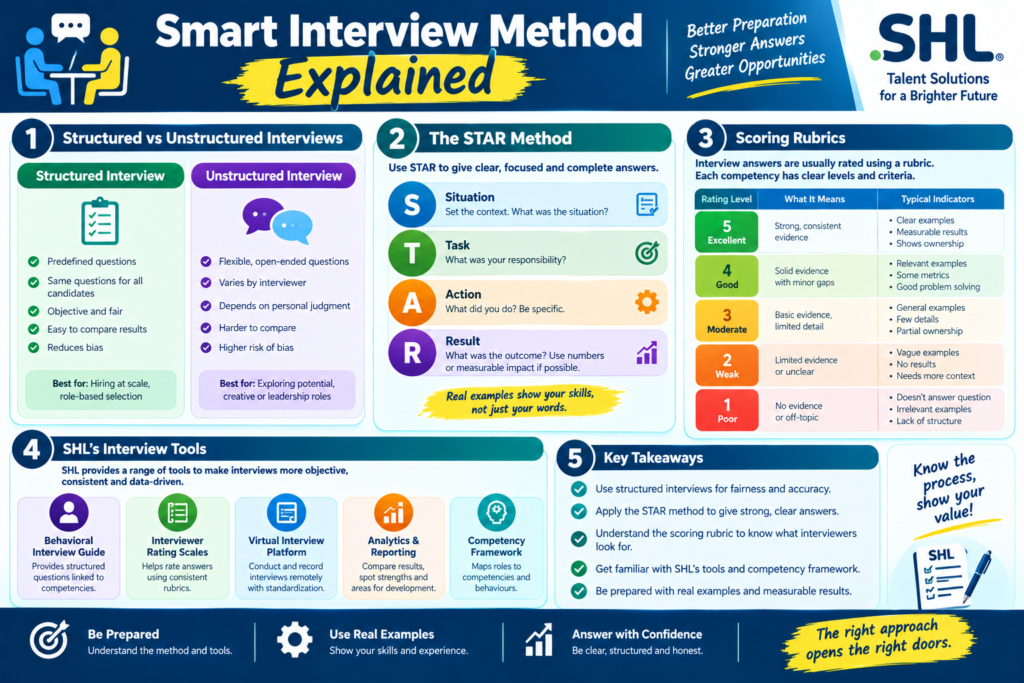
The smart interview method runs interviews the scientific way: structured, scored, and consistent, instead of conversational and improvised. SHL's own research makes a bold case for it. The method matters to candidates because structured interviews reward preparation in a way casual chats do not. Overall, this page explains the method, compares it with unstructured interviews, and tests you with 10 original practice items.
At its core, a structured interview asks every candidate the same predetermined questions in the same order, then scores every answer on the same predetermined rating scale. An interview guide holds the questions and scoring criteria together. As a result, interviewers stay on track, and candidates get judged on evidence rather than charm.
Smart interview method overview
| Detail | Information |
|---|---|
| What it is | SHL's structured-interview solution: same questions, same order, same scoring |
| Two products | Smart Interview Professional (late-stage selection) and Smart Interview on Demand (high-volume video shortlisting) |
| Key claim | SHL reports structured interviews are five times more effective than unstructured ones at predicting job performance |
| Research note | SHL research: three to four unstructured interviews match one structured interview's accuracy |
| Core tools | Interview guide, question library mapped to 800+ roles, scoring framework |
| Candidate skill | STAR answers: Situation, Task, Action, Result |
| On this page | Quick answer, structured vs unstructured, STAR method, 10 practice questions, a timed quiz and FAQs |
Smart interview method: the quick answer
In short, the smart interview method is a structured interview process in which all candidates answer the same predetermined questions in the same order, and interviewers score each answer against the same predetermined rating scale. In addition, SHL Smart Interview tools add an interview guide, a question library, and analytics on top of that structure. Above all, the goal is hiring decisions based on comparable evidence instead of gut feeling.
- To begin with, same questions, same order, same scale for every candidate
- An interview guide holds questions and scoring criteria together
- Structured interviews reduce bias and improve comparability
- Finally, candidates win by preparing STAR stories matched to the role's competencies
Structured vs unstructured interviews
In contrast, unstructured interviews feel friendly. The interviewer chats, follows interesting threads, and tailors questions to each candidate's background. However, the problem is comparability. When no two interviews are the same, no two candidates can be fairly compared, and bias slips in through small talk and first impressions.
Structured interviews fix that by design. Every candidate faces the same questions and the same scoring, so differences in scores reflect differences in evidence. Specifically, SHL reports that structured interviews are five times more effective than unstructured ones at predicting job performance.
SHL also reports that three to four unstructured interviews are needed to match the accuracy of a single structured one. Those are SHL's research claims, and therefore they explain why large employers standardize. Interview scoring uses fixed rubrics instead of gut feeling, while the assessment side of hiring is covered in our assessment test hub and competency framework guide, since interview questions are usually mapped to competencies.
The STAR method for interview answers
In essence, the STAR method turns an experience into evidence in four beats. Situation sets the scene, task states your responsibility, action describes exactly what you did, and result states what changed, ideally with a number.
Weak answers, however, skip beats. They describe the team instead of their own action, or they end without a result. Strong answers, in contrast, keep the spotlight on the candidate and close with a measurable outcome. So, for any STAR method interview, practice two STAR stories per competency the role emphasizes, and keep each story under two minutes.
Structured interview questions to practice
The 10 items below are original practice items written for this guide. They are not real SHL interview questions. They test the method itself and the STAR technique. Answers follow in the next section.
- A hiring team in Austin interviews 12 analysts. Each candidate gets the same eight questions in the same order. What kind of interview is this? Options: A) Structured interview — B) Unstructured interview — C) Panel debate — D) Phone screen
- A candidate in Seattle tells a STAR story that ends with and then the team celebrated. Which STAR part is weakest? Options: A) Situation — B) Task — C) Action — D) Result
- An interviewer in Denver asks every candidate: Tell me about a time you handled an angry customer. What makes this question structured? Options: A) It is asked identically to every candidate — B) It is friendly — C) It has no scoring guide — D) It takes under a minute
- Two interviewers in Boston score the same recorded answer. One gives 4 out of 5, the other gives 2. What should the team fix first? Options: A) The recording quality — B) The interview scoring rubric and rater calibration — C) The interview room — D) The candidate list
- A retailer in Atlanta must screen 2,000 seasonal applicants in two weeks. Which SHL option fits best? Options: A) Smart Interview Professional — B) Smart Interview on Demand — C) A single panel day — D) Walk-in chats
Questions 6 to 10
- A candidate's STAR answer runs four minutes and covers three projects at once. What is the main problem? Options: A) It is too honest — B) It buries one clear action and result — C) It names too many people — D) It uses numbers
- A Chicago bank writes its interview guide before posting a role. Why does that order matter? Options: A) It impresses applicants — B) It locks questions and scoring to the role's competencies — C) It shortens job ads — D) It replaces hiring managers
- A panel in Phoenix lets each member ask whatever comes to mind. What happens to fairness? Options: A) Nothing, since panels are always fair — B) Scores stop being comparable across candidates — C) Interviews finish faster — D) Notes improve
- Before a video interview, a candidate in Dallas tests lighting, audio, and camera angle. Why does that check matter? Options: A) It guarantees a job offer — B) It removes avoidable distractions from the evidence — C) It replaces STAR preparation — D) It shortens answers
- An interviewer asks: What was your own responsibility in that project? Which STAR part does this probe? Options: A) Situation — B) Task — C) Action — D) Result
Answers and explanations
Answers 1 to 5
- A. Identical questions in an identical order are the definition of a structured interview.
- D. A celebration is not a measured outcome, so the Result still needs a concrete change or number.
- A. The same behavioral question for every candidate keeps the evidence comparable.
- B. Wide gaps on identical evidence point to the rubric or rater training, not the candidate.
- B. On Demand lets candidates record answers at their convenience, so thousands can be reviewed quickly for shortlisting.
Answers 6 to 10
- B. Scorers grade one story at a time, so a long multi-project answer hides the evidence they need.
- B. A guide built from the role's competencies keeps every interviewer judging the same evidence.
- B. Different questions produce different evidence, so scores cannot be compared fairly.
- B. Clean audio and framing let scorers focus on the answer instead of the setup.
- B. Asking about personal responsibility probes the Task, the part that sets up the action.
Overall, the thread through every answer is comparability. Structured interviews work because they force the same evidence standard on everyone. STAR works because it packages your evidence in the form scorers can grade.
How to prepare for a structured interview
- To begin with, read the job description, list its competencies, and prepare two STAR stories per competency
- Keep stories under two minutes, with your own action in the middle and a number at the end
- Practice out loud, because written stories always sound better than spoken ones
- In addition, for video interviews, frame the camera at eye level and look at the lens, not the screen
- Above all, answer the question asked, not the question you wish had been asked
- Finally, prepare one question about the role's success measures to ask at the end
Play the timed quiz below to check the method, then rehearse your STAR stories until they feel like conversation rather than recitation. Interviews usually sit beside tests, so our situational judgement test guide covers the other half of many hiring processes.
Timed game: smart interview practice quiz
Play the timed practice game: 10 questions, 5 minutes on the clock, instant score and explanations at the end. No sign-up, no calculator.
Frequently asked questions
About the method
What is the smart interview method?
It is SHL's structured-interview approach: identical predetermined questions, asked in the same order, and scored on the same rating scale for every candidate. An interview guide, a question library, and interviewer analytics support the process. As a result, decisions rest on comparable evidence rather than gut feeling.
What is the difference between structured and unstructured interviews?
Structured interviews use identical questions and scoring for every candidate, which makes scores comparable and reduces bias. Unstructured interviews are conversational and tailored per candidate. Consequently, no two unstructured interviews are alike, and fairness suffers.
What is Smart Interview on Demand?
Smart Interview on Demand is SHL's asynchronous video solution for high-volume hiring. Candidates record answers at their convenience. Automated scoring then helps recruiters review thousands of candidates quickly for shortlisting.
Answering well
What is the STAR method?
STAR stands for Situation, Task, Action, and Result. It structures an interview story: set the scene, state your responsibility, describe what you personally did, and close with the measurable result. Interviewers score STAR answers easily because the evidence is organized.
How long should a STAR answer be?
Aim for under two minutes per story. Use one sentence for situation, one for task, the bulk for your action, and one clear result. Longer answers lose the scorer's attention and bury your evidence.
Do structured interviews really predict performance better?
SHL reports structured interviews are five times more effective than unstructured ones at predicting job performance. SHL also reports that three to four unstructured interviews match one structured interview's accuracy. These are SHL's research claims, and they are why large employers standardize interviews.
Related guides and jobs
- Verbal Reasoning Test: Questions & Answers
- Numerical Reasoning Test Questions & Answers
- Situational Judgement Test Questions & Answers
- Inductive Reasoning Test: Sample Questions
- Deductive Reasoning Test: Questions & Answers
- Assessment Test: Free SHL Practice Test Guide
- OPQ Test: SHL Personality Questionnaire Guide
- SHL Checking Test: Practice Questions & Answers
- Mental Aptitude Test: Free Practice Online
- Psychometric Assessment Test Online Guide
- Technical Skills Assessment: Practice & Guide
- Competency Framework Explained: SHL UCF Guide
- 360 Assessment Tool: 360-Degree Feedback Guide
- SHL Assessment Answers: What to Know First
- Smart Interview Method: Structured Interviews
- HiPo Analysis: Identify Future Leaders
- Behavioral Test: What Employers Measure
- Enterprise Leadership: Build Strong Leaders
- Skills-Based Organization Guide for US Teams
- What Is SHL? Assessments Explained Simply
- Wonderlic Practice Test – Free Sample Test
- Latest Jobs in Pakistan