
A behavioral test helps employers answer a simple question: how will this person likely behave at work? For example, it looks at work style, teamwork, customer handling, and response to pressure. In addition, it checks fit for the role and the culture, not just whether a candidate can do a task.
SHL, a global assessment company, offers behavioral assessment tools that give candidates engaging previews of a role while helping employers sift applicants at scale. As a result, this guide explains the category in plain language, covers its main types, and gives you 10 original practice questions. These questions teach the concepts, and they are not real SHL test items.
Behavioral test overview
| Detail | Information |
|---|---|
| What it is | A hiring assessment that measures likely workplace behavior and fit |
| What it measures | Behavioral fit: work style, teamwork, customer handling, and response to pressure |
| Main types | Realistic job previews, situational judgement tests, and behavioral questionnaires |
| When employers use it | Often at the start of the hiring process, according to SHL |
| SHL match score | SHL says it gives an overview of how a candidate will perform in a specific role |
| Design | SHL says its behavioral assessments use mobile-first technology for any device |
| Who takes it | US candidates for customer service, retail, healthcare, graduate, and supervisory roles |
| What it is not | A skills test, a personality diagnosis, or a hiring guarantee |
| On this page | Quick answer, what it measures, types, employer use, 10 practice questions, a timed quiz, and FAQs |

Behavioral test: the quick answer
A behavioral test is a pre-employment assessment that measures how a candidate will likely behave in a job. Employers use it to judge behavioral fit, so they compare a candidate's likely actions with the behavior that succeeds in that role. Therefore, it sits beside skills tests, rather than replacing them.
- Behavioral assessment tools focus on fit, while ability tests focus on what a candidate can do
- SHL says its realistic job previews and situational judgement tests give engaging role previews
- In addition, SHL says these tools help employers sift the applicant pool for best-fit applicants at scale
- As a result, employers save time, because poor-fit candidates leave the process earlier
- Candidates also gain, since a preview shows the real job before they commit to it
What behavioral assessments measure
Behavioral assessments measure patterns, not single answers. For example, one answer about handling an angry customer means little alone. However, a pattern across teamwork, honesty, customer focus, and rule-following paints a fuller picture. In short, employers look for consistency across items.
Consider two US customer service candidates. One candidate knows every product fact yet grows rude under pressure. In contrast, the other candidate stays calm, explains clearly, and follows policy. Overall, the second candidate may show stronger behavioral fit, even though the first candidate knows more facts.
Fit has two parts. First, role fit covers the daily behavior the job demands, such as patience on calls or care with details. Second, cultural fit covers shared norms, such as teamwork, honesty, and customer focus. Consequently, a behavioral assessment tool should measure both parts, not just charm in an interview.
Types of behavioral assessments
Realistic job previews
A realistic job preview shows candidates what the job truly involves. For example, SHL describes its previews as engaging, with animation, interactive video, and branded multimedia. As a result, candidates learn about tough shifts, hard customers, and team routines before they apply. In addition, employers gain, because candidates who dislike the reality self-select out early.
Situational judgement tests
A situational judgement test presents a realistic workplace scene and asks how the candidate would respond. Employers then compare those responses with effective behavior for the role. For the full format, scoring rules, and practice scenes, see our situational judgement test guide. This page covers the category instead, so it does not repeat that guide's scenarios.
Behavioral questionnaires
A behavioral questionnaire asks candidates to rate statements about their usual work behavior. For example, items may cover teamwork, persistence, and response to change. Therefore, these tools suit early screening, where employers need a quick fit signal across many applicants. However, they differ from a personality questionnaire, which maps broader traits, so read our OPQ test guide for that format.
How US employers use behavioral assessments
US employers often place behavioral assessments early in hiring. SHL says employers can use them to introduce candidates to the organization and discover fit, which often happens at the start of the process. As a result, recruiters spend interview time on best-fit candidates instead of the whole pool.
SHL also says its behavioral assessments reduce the risk of assessing candidates who may not be a role or cultural fit, saving recruitment teams time and money. In other words, early fit screening protects interview time and lowers early turnover risk. However, no assessment guarantees a hire, and employers still interview, check references, and verify skills.
The candidate experience matters too. SHL says its behavioral tests use interactive, immersive formats to keep candidates engaged, and mobile-first technology lets candidates complete them anywhere, at any time, on any device. For example, a candidate in Ohio can finish a preview on a phone during a break, while a recruiter in Texas reviews the match score the same day.
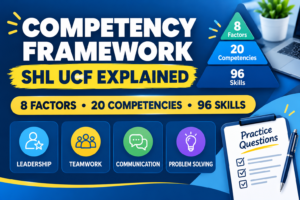
For the broader hiring picture, start at our assessment test hub, and for behavior at work in general, see our competency framework guide.
Behavioral test practice questions
These 10 questions are original practice items about behavioral assessment concepts. They are not real SHL test items, and SHL does not publish its behavioral items. For each question, choose the best answer, then check the explanations below.
Questions 1 to 3
- What does a behavioral test mainly measure in hiring? Options: A) Typing speed — B) How a candidate will likely behave at work — C) College grades — D) Software knowledge
- An employer wants candidates to see the real job before they apply. For example, which tool fits that goal best? Options: A) A realistic job preview — B) A math test — C) A resume screen — D) A salary survey
- A company screens hundreds of applicants for one US retail role. Therefore, which benefit of behavioral assessments matters most here? Options: A) Longer interviews — B) Sifting the pool at scale for best-fit applicants — C) Higher pay offers — D) Fewer job ads
Questions 4 to 6
- A candidate scores well on skills yet clashes with every team norm. In contrast, another candidate fits the team style and learns fast. What does behavioral fit add here? Options: A) Nothing useful — B) A view of role and cultural fit beside skill — C) A pay grade — D) A degree check
- SHL says its behavioral assessments use a match score. What does that score give employers, according to SHL? Options: A) A salary figure — B) An overview of how a candidate will perform in a specific role — C) A hiring guarantee — D) A test pass mark
- A candidate takes a behavioral assessment on a phone during a commute. However, the employer worries about device limits. What does SHL say about its design? Options: A) It needs a desktop only — B) It uses mobile-first technology for any device — C) It needs a proctor on site — D) It runs on paper only
Questions 7 to 10
- An employer keeps interviewing people who quit within a month. As a result, which SHL claim speaks to that problem? Options: A) Behavioral assessments reduce the risk of assessing poor-fit candidates — B) Assessments raise pay — C) Assessments replace interviews — D) Assessments shorten job ads
- A hiring team uses a behavioral test after the final interview. Meanwhile, SHL describes a different timing. When does SHL say employers often use these tools? Options: A) Only after hiring — B) At the start of the hiring process — C) Only at promotion time — D) Only in exit interviews
- Which answer style helps most on a behavioral questionnaire? Options: A) Pick the most impressive answer every time — B) Answer honestly and consistently — C) Copy a friend's answers — D) Skip hard items
- A candidate loves the job preview but dislikes the shift pattern it shows. Therefore, what is the smartest next step? Options: A) Apply anyway and complain later — B) Withdraw and target roles with a better shift fit — C) Hide the concern in interviews — D) Demand a new shift at once
Answers and explanations
Answers 1 to 5
- B. In short, a behavioral test looks at likely workplace behavior, not at academic grades or typing speed.
- A. Specifically, a realistic job preview shows the role itself, so candidates can judge fit early.
- B. As a result, SHL says its behavioral tools help employers sift applicants at scale for best fit.
- B. In other words, behavioral fit shows whether a person suits the role and culture, not just the task list.
- B. For example, SHL describes the match score as an overview of likely performance in a specific role.
Answers 6 to 10
- B. In fact, SHL says all its behavioral assessments use mobile-first technology, so candidates can complete them anywhere.
- A. Consequently, SHL says its behavioral assessments reduce the risk of assessing candidates who may not fit.
- B. Specifically, SHL says employers can use behavioral assessments to introduce candidates and discover fit at the start of hiring.
- B. Above all, honest and consistent answers give a truer picture, while faking often creates contradictions.
- B. In short, a preview works both ways: it helps candidates self-select out of a poor fit early.
In short, each explanation points back to one idea: fit, preview, scale, or honesty. Therefore, when you miss a question, name the idea you misjudged before moving on. As a result, your understanding improves faster than it would from memorizing answers.
How to approach a behavioral assessment
- Answer honestly, because inconsistent answers weaken your fit signal
- Read each preview carefully, and note shift patterns, team norms, and customer demands
- Think about the role, not the ideal worker, since fit means fit for this job
- Stay consistent across items, because patterns matter more than single answers
- Use the preview to judge the employer too, and withdraw from a poor fit early
- Prepare examples from real work, so interview answers match your assessment pattern
Candidates cannot game a behavioral assessment tool for long, because inconsistent or exaggerated answers create contradictions. Therefore, treat the assessment as a two-way check: the employer judges your fit, and you judge the job. In short, a good fit helps both sides, while a forced fit rarely lasts. For interview follow-up, pair this page with our smart interview method guide.
Timed game: behavioral test practice quiz
Play the timed practice game: 10 questions, 5 minutes on the clock, instant score and explanations at the end. No sign-up, no calculator.
Frequently asked questions
About behavioral tests
What is a behavioral test?
A behavioral test is a pre-employment assessment that measures how a candidate will likely behave at work. It looks at work style, teamwork, customer handling, and response to pressure, so employers can judge behavioral fit for a specific role.
What do SHL behavioral assessments measure?
SHL says its behavioral assessments measure behavioral fit and increase commitment. Its realistic job previews and situational judgement tests give candidates engaging previews of the role, while helping employers sift applicants at scale for best-fit candidates.
How is a behavioral test different from a personality test?
A behavioral test focuses on likely behavior in a specific job, while a personality questionnaire maps broader traits across situations. Therefore, employers may use both: a behavioral tool for role fit and a personality questionnaire for deeper trait insight.
Taking a behavioral assessment
When do employers use behavioral assessments?
SHL says employers can use behavioral assessments at the start of the hiring process to introduce candidates to the organization and discover fit. Early use helps recruiters focus interviews on best-fit applicants.
What is the SHL match score?
SHL says it uses a match score to give an overview of how a candidate will perform in a specific role. SHL does not publish a score scale on its behavioral assessments page, so this guide claims no cutoff or pass mark.
Are the practice questions on this page real SHL test items?
No. The 10 questions on this page are original practice items written for this guide. SHL does not publish its behavioral assessment items, so use these questions to learn the concepts, not to memorize answers for a real assessment.
Related guides and jobs
- Verbal Reasoning Test: Questions & Answers
- Numerical Reasoning Test Questions & Answers
- Situational Judgement Test Questions & Answers
- Inductive Reasoning Test: Sample Questions
- Deductive Reasoning Test: Questions & Answers
- Assessment Test: Free SHL Practice Test Guide
- OPQ Test: SHL Personality Questionnaire Guide
- SHL Checking Test: Practice Questions & Answers
- Mental Aptitude Test: Free Practice Online
- Psychometric Assessment Test Online Guide
- Technical Skills Assessment: Practice & Guide
- Competency Framework Explained: SHL UCF Guide
- 360 Assessment Tool: 360-Degree Feedback Guide
- SHL Assessment Answers: What to Know First
- Smart Interview Method: Structured Interviews
- HiPo Analysis: Identify Future Leaders
- Enterprise Leadership: Build Strong Leaders
- Skills-Based Organization Guide
- What Is SHL? Assessment Company Guide
- Wonderlic Practice Test – Free Sample Test
- Jobs for Fresh Graduates
- Latest Jobs in Pakistan


1 thought on “Behavioral Test: What Employers Measure”