A competency framework is how an organization writes down, in plain behavior language, what good work actually looks like. Instead of vague praise for talent, it names the behaviors that deliver results, so hiring, development and promotion can all use the same yardstick. SHL's Universal Competency Framework is the most widely used example, and this page explains it in plain language with 10 original practice questions.
The core distinction, however, is behaviors versus knowledge. SHL defines a competency as a set of behaviors instrumental in the delivery of desired results, which means the framework judges what people do, not what they know. Candidates meet it inside personality questionnaires, interviews and assessment exercises that are scored against it, so understanding it is a genuine advantage.
Competency framework overview
| Detail | Information |
|---|---|
| What it is | A structured model of workplace behaviors that drive performance |
| Famous version | SHL Universal Competency Framework (UCF) |
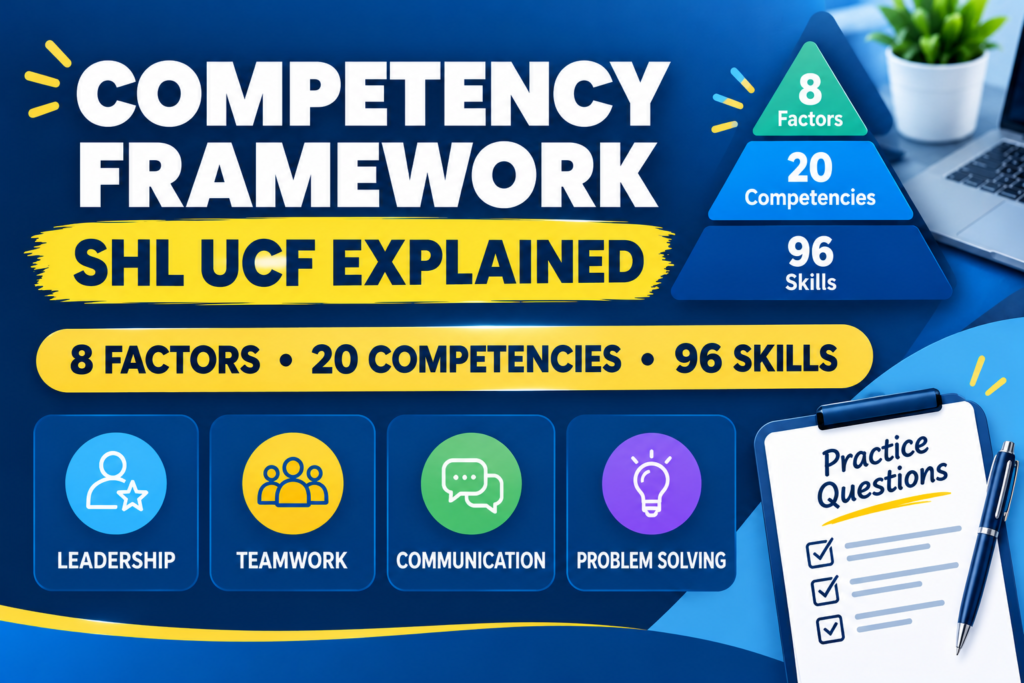
| Structure | Three tiers: 8 broad factors, 20 competencies, 96 skills |
| Origin | First released 2001, major update 2019; research published by Bartram (2005) |
| What it is not | Not job-specific knowledge, not a performance standard, not a physical ability |
| Used for | Hiring, onboarding, development, retention and performance conversations |
| On this page | Quick answer, the 8 factors, the 3 tiers, 10 original practice questions, a timed quiz and FAQs |
Competency framework: the quick answer
A competency framework is a model that defines the behaviors an organization expects from its people, grouped into competencies and skills. Employers use it to write accurate job descriptions, choose fair assessments, run structured interviews and plan development. Because the model describes behaviors rather than knowledge, the same framework can compare candidates across different roles and levels.
- A competency is an observable behavior family, like deciding, supporting or analyzing
- Skills are the smaller, concrete behaviors that show a competency in a specific role, so a single competency can look different in two jobs
- Frameworks therefore align hiring, development and performance around one shared language
- A good framework is measurable, so assessors can observe and score every behavior
The 8 broad factors of SHL's UCF
SHL's UCF has three tiers. Above all, the top tier holds 8 broad factors, the high-level families of behavior that drive performance at work. Then, the middle tier holds 20 competencies, the level most often used to describe what a role needs. Finally, the bottom tier holds 96 skills, the narrow behaviors that make up SHL's Global Skills Taxonomy.
Specifically, the 8 broad factors are Leading & Deciding, Supporting & Co-operating, Interacting & Presenting, Analyzing & Interpreting, Creating & Conceptualizing, Organizing & Executing, Adapting & Coping, and Enterprising & Performing. Notice, for example, how the list covers the whole working day: deciding, helping, presenting, analyzing, inventing, organizing, adapting and selling. Employers pick the factors a role needs most, and then measure them with questionnaires, interviews and exercises. For the personality side of assessment, see our OPQ test guide.
Competency framework practice questions
For each workplace behavior, choose the broad factor it best shows. These 10 original practice items train the same matching skill that competency-based questionnaires and interviews test, so treat each one as a mini case study. They are not real SHL test items.
- A Chicago store manager sets weekly sales targets and assigns shifts. Which broad factor does this show? Options: A) Organizing & Executing — B) Enterprising & Performing — C) Adapting & Coping — D) Creating & Conceptualizing
- A Seattle support agent stays patient with an upset caller and finds a workaround. Which broad factor does this show? Options: A) Leading & Deciding — B) Supporting & Co-operating — C) Analyzing & Interpreting — D) Enterprising & Performing
- A Denver sales lead delivers the quarterly pitch to 200 retailers. Which broad factor does this show? Options: A) Organizing & Executing — B) Adapting & Coping — C) Interacting & Presenting — D) Supporting & Co-operating
- A Dallas data analyst compares two vendor quotes line by line before recommending one. Which broad factor does this show? Options: A) Enterprising & Performing — B) Leading & Deciding — C) Interacting & Presenting — D) Analyzing & Interpreting
- An Austin design team sketches five fresh concepts for a banking app. Which broad factor does this show? Options: A) Creating & Conceptualizing — B) Organizing & Executing — C) Supporting & Co-operating — D) Adapting & Coping
Questions 6 to 10
- A New York nurse covers a colleague's shift when the schedule changes overnight. Which broad factor does this show? Options: A) Leading & Deciding — B) Adapting & Coping — C) Analyzing & Interpreting — D) Enterprising & Performing
- An Ohio factory owner opens a second plant after landing a big contract. Which broad factor does this show? Options: A) Supporting & Co-operating — B) Organizing & Executing — C) Enterprising & Performing — D) Creating & Conceptualizing
- A Boston principal picks a new reading program and stands behind the choice. Which broad factor does this show? Options: A) Adapting & Coping — B) Interacting & Presenting — C) Analyzing & Interpreting — D) Leading & Deciding
- A Phoenix team lead thanks each member by name in the project review. Which broad factor does this show? Options: A) Enterprising & Performing — B) Supporting & Co-operating — C) Leading & Deciding — D) Organizing & Executing
- A Portland engineer runs A/B tests on two checkout designs and reports the winner. Which broad factor does this show? Options: A) Creating & Conceptualizing — B) Enterprising & Performing — C) Analyzing & Interpreting — D) Supporting & Co-operating
Answers and explanations
Answers 1 to 5
- A. Setting targets and assigning shifts is Organizing & Executing, because that factor covers planning and delivery.
- B. Staying patient with an upset caller and finding a workaround sits under Supporting & Co-operating, because that factor covers helping others.
- C. Delivering a pitch to 200 retailers is Interacting & Presenting, because that factor covers presenting ideas to an audience.
- D. Comparing quotes line by line to recommend one is Analyzing & Interpreting, because that factor covers examining evidence.
- A. Sketching fresh concepts belongs to Creating & Conceptualizing, because that factor covers generating new ideas.
Answers 6 to 10
- B. Covering a shift when the schedule changes overnight is Adapting & Coping, because that factor covers handling change with composure.
- C. Opening a second plant after landing a big contract is Enterprising & Performing, because that factor covers pursuing growth.
- D. Picking a program and standing behind the choice is Leading & Deciding, because that factor covers making decisions and owning them.
- B. Thanking each team member by name is Supporting & Co-operating, because that factor covers backing the team.
- C. Running A/B tests and reporting the winner is Analyzing & Interpreting, because that factor covers testing ideas against evidence.
Overall, the pattern is worth memorizing: each factor answers one question about work: who decides, who helps, who presents, who analyzes, who invents, who organizes, who adapts, and who sells? When a behavior fits two factors, however, pick the one the behavior serves most directly. These competency examples cover all 8 factors, so you can test yourself on each one.
How to use a competency framework in your career
- Read the job description and underline its behavior words, then match them to factors
- Prepare interview stories in STAR form, with one story per factor the role emphasizes, so interviewers can score you cleanly
- Answer questionnaires honestly, because frameworks measure patterns and faking breaks the pattern
- Also use the framework for development: pick one factor per quarter and practice its skills
- In performance reviews, describe your work in behavior language instead of task lists
- For hiring teams, define the factors before writing questions, never after, because the criteria must come first
Candidates who speak the framework's language stand out, because interviewers score against it whether or not they name it. Play the timed quiz on this page until the 8 factors feel automatic, and then retake it after a week. Then see how frameworks meet real feedback in our 360 assessment tool guide.
Timed game: competency framework practice quiz
Play the timed practice game: 10 questions, 5 minutes on the clock, instant score and explanations at the end. No sign-up, no calculator.
Frequently asked questions
About the framework
What is a competency framework?
A competency framework is a structured model of the behaviors behind good performance, organized into competencies and skills. Employers use it to define roles, hire fairly, run interviews and plan development, so every people decision uses the same yardstick. In fact, SHL's Universal Competency Framework is the best-known example.
What are the 8 broad factors of SHL's UCF?
The 8 broad factors are Leading & Deciding, Supporting & Co-operating, Interacting & Presenting, Analyzing & Interpreting, Creating & Conceptualizing, Organizing & Executing, Adapting & Coping, and Enterprising & Performing. They sit above 20 competencies and 96 skills in the framework's three tiers, so the model stays consistent from broad factors to narrow skills.
What is the difference between a competency and a skill?
A competency is a broad behavior family, such as Analyzing & Interpreting, while a skill is a narrow, observable behavior inside it, such as checking data for errors. Competencies describe what matters broadly, while skills show how it looks in a specific role.
Using the framework
How do employers use competency frameworks in hiring?
Employers start by defining the competencies a role needs, and then choose assessments and interview questions that measure exactly those behaviors. That keeps hiring consistent and fair, because every candidate faces the same criteria. Frameworks also guide onboarding and development after hiring.
Can a competency framework help my career?
Yes. When you match your interview stories and development goals to the framework's factors, your strengths become legible to employers. Pick one factor per quarter, practice its skills, and then describe your achievements in behavior language in reviews.
Is the UCF used for all job levels?
Yes. SHL designed the UCF to apply from entry level to senior leader, with the same three tiers throughout, so one model covers every level. The factors stay constant, while the skills under them change with the role's demands.
Related guides and jobs
- Verbal Reasoning Test: Questions & Answers
- Numerical Reasoning Test Questions & Answers
- Situational Judgement Test Questions & Answers
- Inductive Reasoning Test: Sample Questions
- Deductive Reasoning Test: Questions & Answers
- Assessment Test: Free SHL Practice Test Guide
- OPQ Test: SHL Personality Questionnaire Guide
- SHL Checking Test: Practice Questions & Answers
- Mental Aptitude Test: Free Practice Online
- Psychometric Assessment Test Online Guide
- Technical Skills Assessment: Practice & Guide
- Competency Framework Explained: SHL UCF Guide
- 360 Assessment Tool: 360-Degree Feedback Guide
- SHL Assessment Answers: What to Know First
- Smart Interview Method: Structured Interviews
- HiPo Analysis: Identify Future Leaders
- Behavioral Test: What Employers Measure
- Enterprise Leadership: Build Strong Leaders
- Skills-Based Organization Guide for US Teams
- What Is SHL? Assessments Explained Simply
- Wonderlic Practice Test – Free Sample Test
- Latest Jobs in Pakistan