
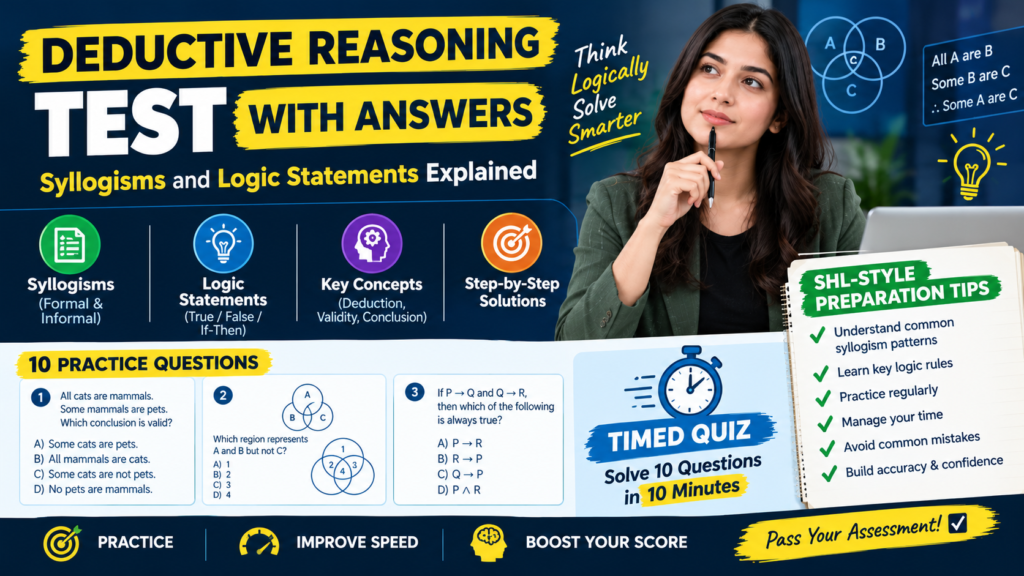
A deductive reasoning test gives you statements and asks whether a conclusion must follow from them. There is no guessing about the real world: if the statements are true, is the conclusion guaranteed? This page teaches the method, works through 10 questions with answers and finishes with a timed quiz game.
Deduction is the mirror image of induction. Inductive items ask you to guess a rule from examples, while deductive items hand you the rules and test whether you apply them exactly. Employers use both, because careful rule-following is the core of compliance, quality and technical work.
Deductive reasoning test overview
| Detail | Information |
|---|---|
| What it measures | Exact logical reasoning from given facts, free of outside assumptions |
| Main format | Statements plus a conclusion to judge Valid, Invalid or Cannot Tell |
| Question families | Syllogisms (all, some, no), if-then rules and ordering problems |
| Key discipline | Use only the given statements, even when real life disagrees |
| Famous family | SHL deductive reasoning test items inside its Verify range |
| On this page | Quick answer, the three statement families, 10 questions with answers, a timed quiz and FAQs |
Deductive reasoning test: the quick answer
A deductive reasoning test is a logic assessment in which you are given statements and must decide whether a conclusion follows with certainty. A conclusion is valid only when it must be true whenever the statements are true. If the conclusion could be false in any situation the statements allow, it is invalid, no matter how likely it sounds.
- All means every single one, and some means at least one
- If-then rules work forwards only: the result never proves the cause
- Only members means every entrant is a member, not that every member enters
- A missing fact means Cannot Tell, never a guess
The three deductive reasoning families
Firstly, syllogisms chain group statements: All A are B, and X is A, so X is B. Secondly, conditional rules chain events: if P happens then Q happens, and the trap is running them backwards. Thirdly, ordering items give relative facts, such as who finished first, and ask you to build the full order.
Each family punishes the same habit: importing real-world knowledge. A deductive reasoning assessment may state something factually odd, and you must still treat it as true inside the question. In contrast, a statement the premises never mention is exactly where scores leak. Train that discipline here, then contrast it with the inductive reasoning test guide, where you infer rules instead of applying them.
Deductive reasoning example questions
Judge each conclusion strictly from its statements. Your options are Valid, Invalid or Cannot Tell, depending on the question.
- All managers have laptops. Sara is a manager. Conclusion: Sara has a laptop. Is the conclusion valid? A. Valid B. Invalid C. Cannot tell
- No cats are dogs. Some pets are cats. Conclusion: Some pets are not dogs. Is the conclusion valid? A. Valid B. Invalid C. Cannot tell
- If a report is late, the manager is informed. This report was late. Conclusion: The manager was informed. A. Valid B. Invalid C. Cannot tell
- If it is a public holiday, the office is closed. The office is closed today. Conclusion: Today is a public holiday. A. Valid B. Invalid C. Cannot tell
- Tom finished before Ann. Ann finished before Lee. Who finished last? A. Tom B. Ann C. Lee
Questions 6 to 10
- All squares are rectangles. Figure X is a square. Conclusion: Figure X is a rectangle. A. Valid B. Invalid C. Cannot tell
- Only members may enter the club. John entered the club. Conclusion: John is a member. A. Valid B. Invalid C. Cannot tell
- Every nurse on Ward A works night shifts. Priya works on Ward A. Conclusion: Priya works night shifts. A. Valid B. Invalid C. Cannot tell
- A is taller than B. C is shorter than B. Conclusion: C is the shortest of the three. A. Valid B. Invalid C. Cannot tell
- If the alarm sounds, staff evacuate the building. The alarm did not sound. Conclusion: Staff did not evacuate. A. Valid B. Invalid C. Cannot tell
Answers and explanations
Answers 1 to 5
- A. Sara belongs to the group that all have laptops, so the conclusion must follow.
- A. The pets that are cats cannot be dogs, so at least some pets are not dogs.
- A. The condition happened, so the stated result must follow.
- B. The office could be closed for another reason, such as maintenance, so the conclusion does not have to follow.
- C. The order is Tom, then Ann, then Lee, so Lee finished last.
Answers 6 to 10
- A. Every square is a rectangle, so a square figure is certainly a rectangle.
- A. Entry is restricted to members, so anyone who entered must be a member.
- C. Priya works on the ward, but the statements never say she is a nurse, so we cannot tell.
- A. The order is A above B above C, so C is indeed the shortest.
- B. Staff might evacuate for a drill or another reason, so the conclusion does not follow from the statements.
Two traps account for most lost marks in these deductive reasoning test examples: running an if-then rule backwards, and assuming a fact the premises never gave. If you fell for either, you are in good company, because the test is designed that way. In short, certainty is a high bar, and likely is not valid.
How to pass a deductive reasoning test
- Translate each statement into a simple chain or order before reading the conclusion
- Ask one question only: must this be true, or could it be false while the statements hold?
- Try to build a counterexample; if one exists, the conclusion is invalid
- Watch the word only, which reverses how most people read a sentence
- Treat some as at least one, possibly all, never as a fixed share
- Ignore real-world truth completely inside the question
The counterexample habit is the master skill. For instance, one imagined case where the office is closed for cleaning breaks the holiday conclusion instantly. Practice it in the timed quiz above, then broaden your preparation with the verbal reasoning test guide.
Timed game: deductive reasoning practice quiz
Play the timed practice game: 10 questions, 5 minutes on the clock, instant score and explanations at the end. No sign-up, no calculator.
Frequently asked questions
About the test
What is a deductive reasoning test?
A deductive reasoning test presents statements and a conclusion, and asks whether the conclusion must follow. It measures exact, rule-based logic. Unlike inductive tests, which ask you to find a pattern, deductive tests hand you the rules and check how carefully you apply them.
What is the difference between inductive and deductive reasoning?
Inductive reasoning moves from examples to a probable rule, like predicting the next figure in a sequence. Deductive reasoning moves from given rules to a certain conclusion, like proving a square is a rectangle. Hiring batteries often include both, because jobs need both skills.
Are deductive reasoning tests timed?
Yes, hiring versions are timed, usually allowing about a minute per item. The questions are short, so most candidates finish; errors come from traps, not from running out of time. A calm counterexample check per item is the best use of the clock.
Scoring and practice
How do I get better at deductive reasoning?
Learn the three families: syllogisms, if-then rules and ordering. Then use the counterexample method on every practice item: try to imagine a case where the statements hold but the conclusion fails. Our timed quiz above drills exactly that habit.
What is a syllogism?
A syllogism is a two-premise argument, such as: all managers have laptops, Sara is a manager, therefore Sara has a laptop. The conclusion is valid when the premises guarantee it. Syllogisms built on all, some and no are the backbone of deductive tests.
Can a conclusion be likely but still invalid?
Yes, and this is the most common trap in the test. If the statements leave any room for the conclusion to be false, it is invalid, even when it sounds probable. Deduction grades certainty only, never likelihood.


1 thought on “Deductive Reasoning Test: Questions & Answers”