
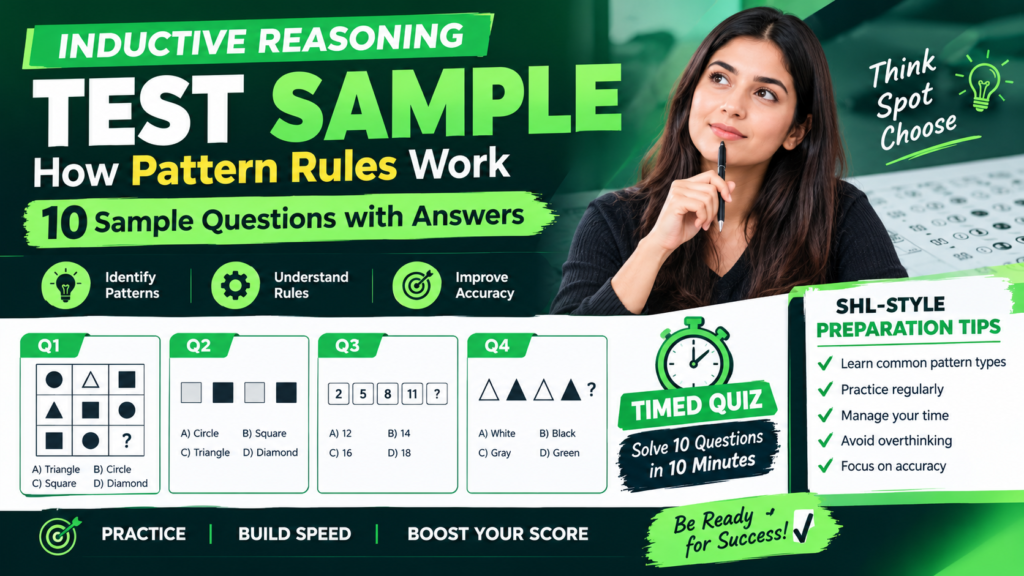
An inductive reasoning test asks you to spot the hidden rule inside a sequence, then use that rule to predict what comes next. In contrast, SHL's version shows sequences of shapes and symbols rather than words or numbers. In addition, this page explains how the rules work, gives you 10 sample questions with answers and ends with a timed quiz game.
Inductive reasoning is the skill of learning from examples, so it predicts how fast a new hire picks up unfamiliar systems. Therefore, employers place it beside verbal and numerical tests in graduate and technical hiring. However, you cannot memorize the sequences, yet you can absolutely train the rule-spotting habit.
Inductive reasoning test overview
| Detail | Information |
|---|---|
| What it measures | Pattern recognition and learning from unfamiliar information |
| Main format | Sequences of shapes or symbols; choose the box that continues the rule |
| Also called | Abstract reasoning or diagrammatic reasoning test |
| Famous version | SHL inductive reasoning test (Verify suite) |
| Common rules | Rotation, shading, counting, alternation, size and position changes |
| On this page | Quick answer, the six common rules, 10 sample questions with answers, a timed quiz and FAQs |
Inductive reasoning: the quick answer
Inductive reasoning is the ability to find a general rule from specific examples. Overall, in a test, you study a sequence of figures, work out what changes from one step to the next, and pick the figure that continues the pattern. For example, a sample inductive reasoning item might rotate a shape by 90 degrees each step while adding one dot, and only one answer option follows both rules. Therefore, treat every sequence as a small puzzle with a discoverable rule.
- Firstly, check one feature at a time: shape, shading, number, size, position, rotation
- In fact, most sequences hide two rules at once, not one
- Alternating rules switch on odd and even positions
- Finally, eliminate options that break any confirmed rule
The six rules behind inductive reasoning patterns
In fact, nearly every inductive reasoning pattern is built from six moves. Firstly, rotation turns a shape by a fixed angle each step. Secondly, shading cycles through black, white and striped fills. Thirdly, counting adds or removes one element per step. Fourthly, alternation swaps two states on odd and even boxes. Fifthly, size grows or shrinks by a steady amount. Finally, position moves an element around fixed points, such as corners. However, every rule announces itself if you track the sequence box by box.
Real SHL sequences combine two moves, for example rotation plus counting. Therefore, your method matters more than your intuition: name each feature, track it across the boxes, and only then look at the options. However, the sample inductive reasoning questions below use letters and numbers so you can practice the same tracking skill in text form. For the logic-based sibling, see the deductive reasoning test guide.
Inductive reasoning sample questions
In short, for each sequence, find the rule and choose what comes next. Time yourself loosely at about 30 seconds per question, which matches real test pace. These inductive reasoning problems use numbers and letters, so the rule-spotting skill transfers directly to shapes.
- What comes next? 3, 6, 11, 18, 27, ___ A. 34 B. 36 C. 38 D. 41
- What comes next? 2, 3, 5, 8, 13, 21, ___ A. 29 B. 31 C. 34 D. 36
- What comes next? A, C, F, J, O, ___ A. T B. U C. V D. W
- What comes next? 81, 27, 9, 3, ___ A. 0 B. 1 C. 2 D. 6
- What comes next? Z, X, V, T, ___ A. S B. R C. Q D. P
Questions 6 to 10
- What comes next? 1, 4, 9, 16, 25, ___ A. 30 B. 32 C. 36 D. 49
- What comes next? 5, 10, 20, 40, ___ A. 60 B. 70 C. 80 D. 100
- What comes next? AB, BC, CD, DE, ___ A. EF B. FG C. DF D. EA
- What comes next? 100, 90, 81, 73, 66, ___ A. 58 B. 59 C. 60 D. 61
- Each figure in a sequence gains one side: triangle, square, pentagon, hexagon. What comes next? A. Circle B. Heptagon C. Octagon D. Rectangle
Answers and explanations
Answers 1 to 5
- C. Indeed, the gaps grow by 3, 5, 7, 9 and then 11, so 27 plus 11 equals 38.
- C. Similarly, each number is the sum of the two before it: 13 plus 21 equals 34.
- B. In fact, the letter gaps grow by 2, 3, 4, 5 and then 6, so O plus 6 letters is U.
- B. So, each term divides by 3, and 3 divided by 3 equals 1.
- B. In contrast, the letters step backwards by 2, so T minus 2 is R.
Answers 6 to 10
- C. Overall, these are square numbers, and the next square after 25 is 36.
- C. Likewise, each term doubles, so 40 times 2 equals 80.
- A. Consequently, both letters advance by one each step, so DE is followed by EF.
- C. In short, the drops shrink by 10, 9, 8, 7 and then 6, so 66 minus 6 equals 60.
- B. Finally, the side count rises 3, 4, 5, 6, so the next figure has 7 sides: a heptagon.
Therefore, each explanation names the rule in plain words, and that habit is the whole technique. In addition, inductive reasoning examples with answers train your eye to check gaps, sums and counts before guessing. In short, verbalize the rule, then answer.
How to pass an inductive reasoning test
- Scan the sequence once for the obvious change before studying details
- Track features in a fixed order: number, shape, shading, size, position, rotation
- Write the rule in words; a rule you cannot say is a rule you have not found
- Use elimination: one broken feature removes an option completely
- Above all, budget about 30 seconds per item and guess rather than stall
- Finally, practice with shapes as well as sequences, because the real test is visual
Overall, short daily drills build this skill faster than long weekend sessions, because pattern recognition is a habit of attention. Meanwhile, play the timed quiz above until naming rules feels automatic. Finally, complete the reasoning family with the numerical reasoning test guide.
Timed game: inductive reasoning practice quiz
Play the timed practice game: 10 questions, 5 minutes on the clock, instant score and explanations at the end. No sign-up, no calculator.
Frequently asked questions
About the test
What is an inductive reasoning test?
An inductive reasoning test shows sequences of shapes or symbols and asks which option continues the pattern. It measures how well you find rules in unfamiliar information. SHL and other providers use it for graduate, technical and professional hiring.
What is an example of inductive reasoning?
Seeing the sequence 3, 6, 11, 18, 27 and predicting 38 is an example: the gaps grow by 3, 5, 7, 9 and 11. In the visual test, the same skill spots a shape rotating while a dot is added each step. Both tasks reward finding the rule from examples.
Is inductive reasoning the same as abstract reasoning?
Yes, in hiring tests the labels overlap. Inductive, abstract and diagrammatic reasoning tests all present visual sequences and ask you to continue the pattern. However, providers prefer different names, yet the underlying skill and preparation are the same.
Scoring and practice
How can I improve my inductive reasoning?
Practice naming the rule behind every sequence you solve. Work through the six common rules: rotation, shading, counting, alternation, size and position. For example, timed sets of 10 questions, like our quiz, build the tracking habit within a week.
How is the SHL inductive reasoning test scored?
Each correct continuation earns one point, and your total is compared with a norm group for the role. However, because sequences hide two rules, partial pattern-spotting earns nothing. Above all, accuracy on medium items usually beats heroic guesses on the hardest ones.
How long does an inductive reasoning test take?
Providers set different lengths, but the pace is consistently fast, at roughly 30 seconds per sequence. Therefore, elimination and a fixed feature order matter at that pace. Practice under a timer so the pace feels normal on test day.


1 thought on “Inductive Reasoning Test: Sample Questions”