
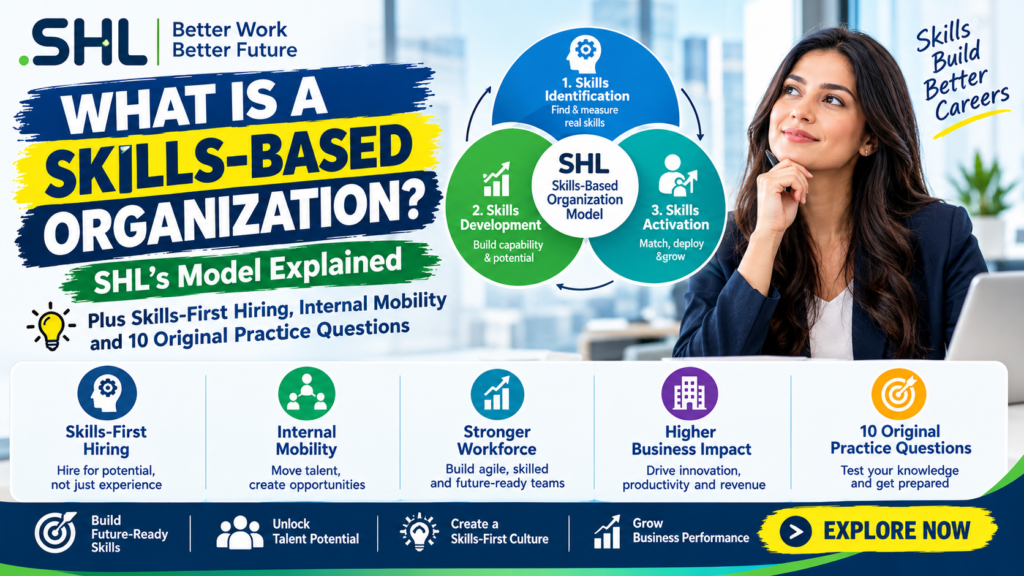
A skills-based organization puts skills first and job titles second. In other words, it identifies, develops, and uses the skills and abilities of its workforce, rather than sorting people only by traditional job roles or hierarchical structures. This guide explains the model in plain language, using SHL's own introduction guide, and adds 10 original practice scenarios.
SHL describes the aim clearly: maximize the potential of employees and align their skills with the goals and needs of the organization. For example, a US employer might staff a project from a skill inventory, hire for a proven capability, or move a strong internal candidate into a new team. As a result, the same person can grow without waiting for a title change. Searchers also write the phrase as skills based organization, without the hyphen, and it means the same model.
Skills-based organization overview
| Detail | Information |
|---|---|
| What it is | An organization that emphasizes identifying, developing, and utilizing workforce skills and abilities |
| Focus instead of titles | Capabilities and competencies of individuals, rather than traditional job roles or hierarchical structures |
| Core aim | Maximize employee potential and align skills with the goals and needs of the organization |
| SHL source | SHL introduction guide to skills-based organizations, citing Deloitte Insights for its statistics |
| Key uses | Skills-first hiring, internal mobility, cross-functional teams, and targeted development |
| Who it suits | US employers, HR teams, managers, and employees planning a skills-first career move |
| What it is not | A promise of promotion, a pay guarantee, or a single software tool |
| On this page | Quick answer, SHL's ten reasons, building steps, 10 practice scenarios with answers, a timed quiz, and FAQs |

Skills-based organization: the quick answer
A skills-based organization hires, staffs, and develops people by what they can do. Employers map skills, test for them, and match them to real work. Therefore, a strong internal candidate can win a role without holding the exact prior title.
- Skills beat titles, because a title hides the actual capabilities behind it
- Internal talent gains visibility, so managers can find hidden skills fast
- Learning stays central, since skill gaps drive training plans
- Teams form across departments, and cross-functional work gets easier
What SHL's guide says: ten reasons to go skills-based
SHL's introduction guide lists ten reasons organizations might choose this model. In short, the reasons cover adaptability, hiring, engagement, and measurable results. Each reason below paraphrases SHL's guide, and the statistics stay attributed to the Deloitte Insights source SHL cites.
Adaptability, talent, and engagement
Adaptability comes first. For example, technology, market conditions, and customer preferences change quickly, so a skills-based organization can adapt more readily by developing relevant skills. In addition, SHL's guide cites Deloitte Insights for a striking claim: companies that adopt this approach are 57% more likely to anticipate change and respond effectively.
Talent management also improves. Specifically, leaders can identify and leverage the specific skills required for tasks or projects, which leads to better resource allocation, reduced skill gaps, and improved workforce efficiency. Meanwhile, engagement rises when employees see investment in their development, because a skills-based culture fosters continuous learning.
SHL's guide cites two more Deloitte figures here. Companies are 63% more likely to achieve results than those that do not adopt a skills-based approach, and companies are 98% more likely to retain high performers if they adopt one. However, treat both figures as cited claims from one source, not as guarantees for any single employer.
Hiring, collaboration, and future readiness
Targeted hiring follows from the same logic. For example, an employer can focus on the specific skills needed for success in a role, which can streamline recruitment and improve hire quality. As a result, SHL's guide cites Deloitte Insights again: companies are 107% more likely to place talent effectively if they adopt a skills-based approach.
Collaboration grows too. In other words, cross-functional teams form when people with diverse skills work toward common goals, and that mix can spark innovation and better problem-solving. Similarly, future-proofing improves, because employees can train in emerging skills while the organization stays competitive.
Results, cost, inclusion, and remote work
Measurable outcomes matter to US managers. For example, skill-based measurement lets leaders track employees on proficiency in key skills, which leads to clearer performance metrics and goals. In addition, cost savings can follow, since better workforce optimization reduces costs tied to hiring, training, and retaining staff who lack required skills.
Inclusion also features in SHL's guide. Specifically, hiring on capability rather than traditional factors can foster a more inclusive and diverse workforce. Finally, globalization and remote collaboration benefit, because skills become a universal language that helps teams work across geographic boundaries.
Building a skills-based organization
Building a skills-based organization starts with a clear skill inventory. First, leaders list the skills each role truly needs, then they record the skills current staff already hold. Next, they compare the two lists and name the gaps.
Hiring changes after that inventory exists. For example, a job post can name the required skills and the test that proves them, rather than listing a degree or a long title history. In addition, internal mobility opens up, because managers can search the inventory before hiring outside.
Development closes the loop. In other words, training targets the gaps the inventory reveals, and employees gain visible paths to new teams. As a result, a skill based organization rewards learning directly, since new skills unlock new work. For skill testing detail, see our technical skills assessment guide, and for the behavior side, see our competency framework guide.
Skills-based organization practice scenarios
These 10 scenarios are original practice items. They are not real SHL test questions, and SHL does not publish skills-based assessment items in this guide. For each scenario, choose the best answer, then check the explanations below.
Scenarios 1 to 3
- A US logistics company fills a warehouse lead role from inside. One candidate holds the exact job title, while another lacks the title yet runs the same systems and trains new staff. Under a skills-based model, which choice fits best? Options: A) Pick the title holder automatically — B) Compare proven skills for the lead role, not titles alone — C) Pick the longest-serving employee — D) Post the role outside only
- A manager says her team lacks data skills. In addition, she plans a training plan and a short project for each person. Which SHL reason does this step support? Options: A) Cost savings only — B) Adaptability through developing relevant skills — C) Inclusive hiring only — D) Remote collaboration only
- Two analysts apply for one project. One analyst has a strong degree yet no dashboard experience. In contrast, the other analyst built dashboards in a prior role. What should a skills-first screen check first? Options: A) The degree alone — B) Demonstrated dashboard skill — C) Age of each applicant — D) Commute distance
Scenarios 4 to 6
- A company maps every employee skill in a simple inventory. As a result, a product launch team forms across three departments in one week. Which benefit does this show? Options: A) Cross-functional collaboration — B) Lower office rent — C) Fewer managers — D) Longer job titles
- An employer drops degree requirements for support roles. However, it keeps a short skills test and a work sample. What does this change most likely improve? Options: A) Inclusive hiring based on capability — B) Office parking — C) Job titles — D) Meeting length
- A nurse manager in Ohio wants to future-proof her unit. For example, she plans training in new charting software before the rollout. Which SHL reason fits this plan? Options: A) Future-proofing by anticipating future needs — B) Cost savings only — C) Globalization only — D) Performance metrics only
Scenarios 7 to 10
- A firm measures staff on skill proficiency for each key task. Therefore, goals look clearer than a vague annual rating. Which SHL reason does this reflect? Options: A) Performance, results, and measurable outcomes — B) Remote collaboration — C) Talent acquisition — D) Diversity alone
- A remote team in Texas, Ohio, and Florida shares one project. In other words, members never meet in person, yet they split work by skill. What does SHL call this advantage? Options: A) Globalization and remote collaboration — B) Hierarchical control — C) Title-based staffing — D) Office-first work
- A company hires a costly outside contractor for a skill its own staff already holds. Meanwhile, nobody checked the internal skill inventory. What step would a skills-based approach add first? Options: A) Check internal skills before hiring outside — B) Raise contractor pay — C) Add more job titles — D) Stop all training
- A leader asks whether a skills-based shift helps retention. In fact, SHL's guide cites a Deloitte figure on this point. What does that cited figure claim? Options: A) Companies are 98% more likely to retain high performers — B) Retention always doubles — C) No worker ever leaves — D) Pay rises by 98%
Answers and explanations
Answers 1 to 5
- B. In short, a skills-based model weighs proven capabilities over job titles, so the trainer with the right skills fits the model better.
- B. Developing relevant skills helps a team adapt to change, which is the first reason in SHL's guide.
- B. Skills-first hiring checks the specific skill the work needs, rather than a proxy such as a degree.
- A. A shared skill view lets leaders form cross-functional teams fast, because they can see who holds each needed skill.
- A. Hiring on capability rather than traditional factors can widen the talent pool, according to SHL's guide.
Answers 6 to 10
- A. Training in emerging skills before demand arrives is future-proofing, because the team stays ready for change.
- A. Skill-based measurement gives clearer performance metrics and goals, since proficiency in key skills is visible.
- A. Skills act as a shared language across locations, so remote teams can collaborate across geographic boundaries.
- A. A skills inventory reveals hidden internal capability, so it can cut wasteful outside hiring and improve resource use.
- A. SHL's guide cites Deloitte Insights for the 98% retention figure, so treat it as a cited claim, not a guarantee.
In short, each explanation points back to one SHL reason or one skills-first rule. Therefore, when you miss a scenario, name the reason you misjudged before moving on. As a result, your judgment improves faster than it would from memorizing answers.
Mistakes to avoid in a skills-first shift
- Renaming titles without mapping real skills, because new labels alone change nothing
- Hiding the skill criteria, since secret rules breed distrust among staff
- Testing only degrees again, which defeats the whole skills-first point
- Ignoring soft skills, although SHL stresses both soft and hard skills matter
- Freezing the inventory, because skills and business needs keep changing
Overall, a skills-based shift works when criteria stay visible, tests stay fair, and learning stays funded. For example, a US team in Chicago might publish its skill list, test candidates on it, and fund training for gaps. In contrast, a team that only rebrands old roles will see little change. Pair this page with our HiPo analysis guide for the talent-identification side, and start at our assessment test hub for the full test battery.
Timed game: skills-based organization practice quiz
Play the timed practice game: 10 questions, 5 minutes on the clock, instant score and explanations at the end. No sign-up, no calculator.
Frequently asked questions
About skills-based organizations
What is a skills-based organization?
A skills-based organization places a strong emphasis on identifying, developing, and utilizing the skills and abilities of its workforce. It focuses on the capabilities and competencies of individuals rather than traditional job roles or hierarchical structures, so it can align skills with the goals and needs of the organization.
What are the benefits of a skills-based organization?
According to SHL's guide, benefits include adaptability, efficient talent management, higher engagement, targeted hiring, cross-functional collaboration, future-proofing, clearer performance measurement, cost savings, inclusive hiring, and easier remote collaboration. The guide cites Deloitte Insights for its statistics, so treat those figures as cited claims rather than guarantees.
How is a skills-based organization different from a traditional one?
A traditional model sorts people mainly by job title and hierarchy, while a skills-based model sorts work by proven capability. Therefore, a skills-based organization can staff projects across departments, hire for specific skills, and move internal talent into new roles without waiting for a title change.
Building and working in one
How do you build a skills-based organization?
Building a skills-based organization starts with a skill inventory: list the skills each role truly needs, record the skills staff already hold, and name the gaps. Then hire against those skills, search internally before hiring outside, and fund training that closes the gaps the inventory reveals.
Does a skills-based organization ignore degrees?
No. A skills-based model weighs proven skills first, but it does not automatically ban degrees or experience. Employers may still value education, yet they should test the actual skill the work needs instead of using a degree as the only screen.
Are the practice questions on this page real SHL test items?
No. The 10 scenarios on this page are original practice items written for this guide. SHL's introduction guide does not publish assessment items, so use these scenarios to learn the concepts, not to memorize answers for a real assessment.
Related guides and jobs
- Verbal Reasoning Test: Questions & Answers
- Numerical Reasoning Test Questions & Answers
- Situational Judgement Test Questions & Answers
- Inductive Reasoning Test: Sample Questions
- Deductive Reasoning Test: Questions & Answers
- Assessment Test: Free SHL Practice Test Guide
- OPQ Test: SHL Personality Questionnaire Guide
- SHL Checking Test: Practice Questions & Answers
- Mental Aptitude Test: Free Practice Online
- Psychometric Assessment Test Online Guide
- Technical Skills Assessment: Practice & Guide
- Competency Framework Explained: SHL UCF Guide
- 360 Assessment Tool: 360-Degree Feedback Guide
- SHL Assessment Answers: What to Know First
- Smart Interview Method: Structured Interviews
- HiPo Analysis: Identify Future Leaders
- Behavioral Test: Practice Questions & Guide
- Enterprise Leadership: SHL Leadership Guide
- Skills-Based Organization Guide for US Teams
- What Is SHL? Assessments Explained Simply
- Wonderlic Practice Test – Free Sample Test
- Jobs for fresh graduates
- Latest Jobs in Pakistan
2 thoughts on “Skills-Based Organization Guide for US Teams”