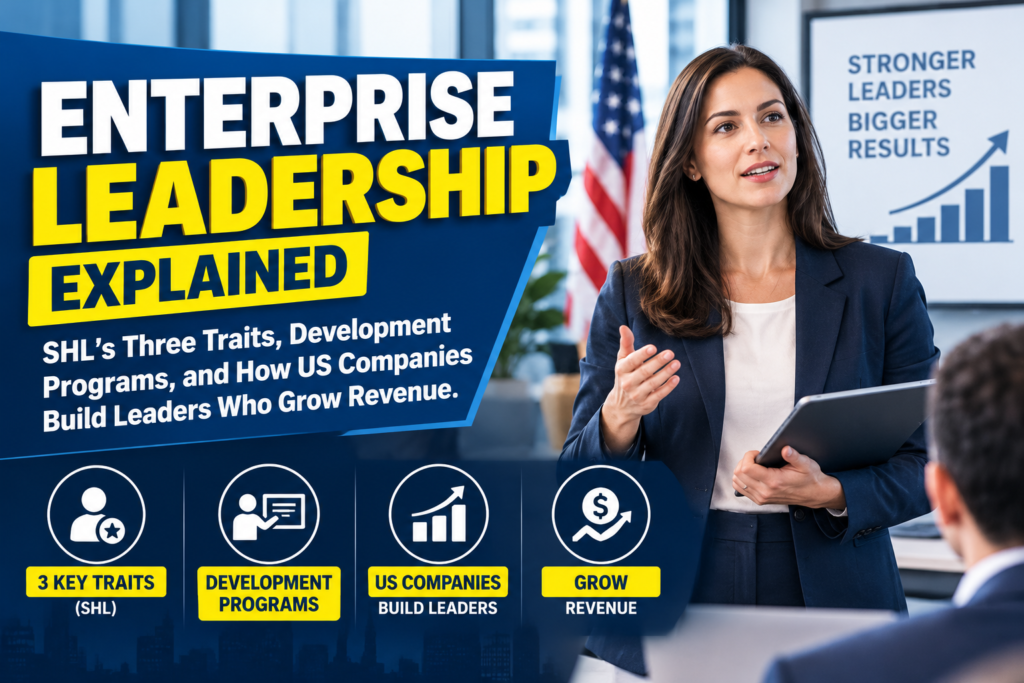
Enterprise leadership means leading across a whole organization instead of just one team. An enterprise leader aligns teams, shapes direction and builds influence beyond formal authority. Because of that, it matters most when change cuts across departments.
SHL, a global assessment company (see our what is SHL guide), built its Enterprise Leadership framework from research with over 1,650 leaders and HR professionals, according to SHL’s Enterprise Leader Development page. This guide explains the framework, the three traits, the outcomes SHL reports and how a development program works. In addition, it includes 10 original practice questions, which are not real SHL items.
Enterprise leadership overview
| Detail | Information |
|---|---|
| What it is | Leading across an organization with an enterprise-wide view, not just one team |
| SHL framework | Three traits: transactional, transformational and network leadership |
| Research base | SHL says its framework draws on research with over 1,650 leaders and HR professionals |
| Revenue result | SHL reports 12% revenue growth from leaders with an enterprise-wide perspective |
| Engagement result | SHL reports 35% higher employee engagement where collaboration between leaders is strong |
| Problem-solving result | SHL reports 21% more problem-solving from leaders who connect across teams |
| Rarity | SHL says only 15% of leaders have all three traits |
| How it is assessed | OPQ personality data, with optional 360 feedback, according to SHL |
| Who it suits | Newly promoted leaders, leaders stepping into bigger roles and leaders widening their impact |
| On this page | Quick answer, the three traits, reported outcomes, program design, 10 practice questions, a timed quiz and FAQs |
Enterprise leadership: the quick answer
Enterprise leadership is leadership that looks across the whole organization. An enterprise leader aligns teams to shared priorities, drives change and builds partnerships beyond one department. Therefore, the test is organization-wide impact, not just strong results inside one team.
- Enterprise leadership means leading with an enterprise-wide view, across teams and functions
- SHL names three traits: transactional, transformational and network leadership
- SHL says leaders who show all three traits drive stronger business performance
- Development starts with assessment data and feedback, then moves to targeted action
- SHL says its solution can run alone or beside a company’s own programs
The three traits in SHL’s framework
SHL’s Enterprise Leadership framework names three traits. Importantly, according to SHL, the most effective leaders are strong in all of them.
Transactional leadership: structure and execution
Transactional leaders make things happen. They turn priorities into plans, keep teams aligned as demands change and make sure strategy ends in results. In short, this trait is the discipline that turns vision into delivered work.
Transformational leadership: vision and momentum
Transformational leaders set the direction. They describe a clear vision, back it with conviction and get people moving, which builds lasting momentum for change. In contrast, a leader who only executes may deliver today’s plan but miss tomorrow’s shift.
Network leadership: influence beyond formal roles
Network leaders get results without relying on job title. Instead, they build relationships across the organization, keep groups aligned and share accountability for outcomes. For example, an operations director who aligns sales, supply and service teams shows network strength, even without authority over all three.
Outcomes SHL reports for enterprise leaders
SHL reports three outcome figures on SHL’s Enterprise Leader Development page. Because they come from SHL, this guide attributes them to SHL instead of treating them as independent facts. Therefore, read them as SHL-reported results, not guarantees for any one company.
| Outcome | SHL-reported result | Trait behind it |
|---|---|---|
| Revenue growth | 12% revenue growth from leaders with an enterprise-wide perspective | Enterprise-wide perspective |
| Employee engagement | 35% higher engagement where collaboration between leaders is strong | Collaboration between leaders |
| Problem-solving | 21% more problem-solving from leaders who connect across teams | Connecting across teams |
In addition, SHL says that only 15% of leaders have all three traits. Overall, SHL’s research links connection and shared perspective to better results. However, one leader cannot lift revenue alone, because market, product and team factors also matter. So use these figures to understand SHL’s case, not to promise a result.
How an enterprise leadership development program works
Insight first, then development
First, a development program built on this framework starts with insight rather than content. SHL says most programs focus on content, while its solution shows how leaders behave, how others see them and where they can grow. As a result, development can target real gaps instead of generic topics.
The assessment tools SHL uses
SHL’s Occupational Personality Questionnaire (OPQ) shows how a leader prefers to work, decide and engage with others. An Enterprise Leader Development Report then turns those results into guidance on where to grow. Also, our OPQ test guide covers the questionnaire in more depth.
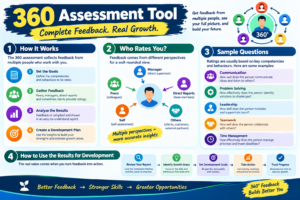
In addition, SHL offers optional 360 feedback that shows how peers, managers and direct reports experience the leader. Together, personality data and 360 feedback give forward-looking insight plus current performance, according to SHL. A digital 360 report also shows how perceptions change over time, so leaders can track progress. Our 360 assessment tool guide covers the feedback side in detail.
Who the program suits
SHL says the solution supports newly promoted leaders, leaders stepping into bigger roles and leaders expanding their impact across the business. It also works on its own or beside a company’s internal programs. For example, a company can run SHL insight next to its own coaching and mentoring.
Reusing data across talent programs
SHL says data can move between its solutions. Insights from high potential (HiPo) identification or succession planning can feed enterprise leader development, and the reverse also works. For the HiPo side, see our HiPo analysis guide.
Enterprise leadership practice questions
These 10 questions are original practice items about the framework. However, they are not real SHL assessment items. For each question, choose the best answer, then check the explanations below.
Questions 1 to 3
- What does enterprise leadership mean in SHL’s framework?
- Managing a single small team well
- Writing company policy without consulting teams
- Leading across the whole organization, not just one team
- Managing payroll and budgets
- A leader sets clear priorities, aligns her team to them and makes sure plans become results. Which SHL trait does this show?
- Transactional leadership
- Transformational leadership
- Network leadership
- Technical leadership
- A leader paints a clear vision, leads with conviction and gets people moving toward change. Which SHL trait does this show?
- Transactional leadership
- Network leadership
- Administrative leadership
- Transformational leadership
Questions 4 to 6
- An operations director has no formal authority over sales or supply, yet builds influence and alignment across both teams. Which SHL trait does this show?
- Transactional leadership
- Network leadership
- Transformational leadership
- Financial leadership
- Which result does SHL report for leaders with an enterprise-wide perspective?
- 12% revenue growth
- 35% revenue growth
- 21% revenue growth
- No measurable change
- A company pairs OPQ personality data with 360 feedback for its leaders. What does SHL say this combination gives?
- A salary band for each leader
- Only a hiring decision
- Just a training calendar
- Forward-looking insight plus current performance
Questions 7 to 10
- A newly promoted manager and a senior director join the same enterprise leader development program. What does SHL say about who the solution is for?
- Only newly promoted leaders
- Leaders at different stages
- Only senior directors
- Only HR staff
- SHL reports 35% higher employee engagement under which condition?
- Teams whose leaders work independently
- Teams with the fastest pay rises
- Strong collaboration between leaders
- Teams that rarely meet
- A company already holds high potential (HiPo) data on its leaders. According to SHL, can it reuse that data in enterprise leader development?
- No, every solution needs fresh data
- Only for new hires
- Yes, SHL solutions such as High Potential Identification let you reuse that data
- Only after a second personality test
- A leader executes plans well and connects teams, but rarely sets a direction for change. Which trait should development target first?
- Transactional leadership
- Network leadership
- Technical leadership
- Transformational leadership
Answers and explanations
Answers 1 to 5
- Enterprise leadership means leading with a view across the whole organization, not only one team.
- Structure, discipline and turning plans into results mark transactional leadership.
- Vision, conviction and momentum for change mark transformational leadership.
- Because this leader builds influence and alignment beyond formal authority, the trait is network leadership.
- Revenue growth of 12% is what SHL reports for leaders with an enterprise-wide perspective; the 35% figure relates to engagement and the 21% figure to problem-solving.
Answers 6 to 10
- The OPQ shows how someone prefers to lead and 360 feedback shows how others experience it, so SHL says together they give forward-looking insight plus current performance.
- The solution supports leaders at different stages, from newly promoted leaders to those expanding their impact, according to SHL.
- Where collaboration between leaders is strong, SHL reports 35% higher employee engagement.
- Data from solutions such as High Potential Identification or Succession Planning can feed enterprise leader development, according to SHL.
- This leader already shows transactional and network strengths, so the gap is vision and momentum for change, which is the transformational trait.
Each explanation points back to one trait or one program fact. So, when you miss a question, name the trait you misjudged before moving on. That habit builds your grasp of the framework faster than memorizing answers. Next, replay the questions in the timed quiz.
Enterprise leadership quiz: 10 timed questions
Replay the 10 practice questions as a timed game: 5 minutes on the clock, with an instant score and explanations at the end. There is no sign-up and no calculator needed.
How to build enterprise leadership capability
However, these are practical steps based on the framework, not SHL requirements.
- Look at all three traits, because strength in one cannot cover weakness in another
- Pair personality insight with 360 feedback, so your self-view meets how others experience you
- Set one development goal per trait and review progress each quarter
- Build cross-team partnerships on purpose, since network strength grows through shared work
- Reuse talent data across HiPo, succession and leader development where your tools allow it
- Track how perceptions change over time, because behavior change shows in feedback before it shows in results
One course cannot build enterprise capability, because the traits grow through repeated cross-team work. Therefore, seek assignments that cross departments, ask peers for honest feedback and act on it visibly. In short, shared goals beat silo wins. For the competency language behind these traits, see our competency framework guide.
Frequently asked questions
About enterprise leadership
What is enterprise leadership?
Enterprise leadership is leadership across the whole organization, not just one team. An enterprise leader aligns teams to shared priorities, drives change and builds influence beyond formal authority. As a result, the impact reaches several departments.
What are the three traits in SHL’s enterprise leadership framework?
SHL’s framework names transactional, transformational and network leadership. Transactional leaders bring structure and execution, while transformational leaders set vision and drive change, and network leaders build influence and alignment across the organization.
How is enterprise leadership assessed?
SHL says it combines personality data from the OPQ with optional 360 feedback and development insights. The OPQ shows how a leader prefers to lead, while 360 feedback shows how other people experience that behavior.
Development programs and practice
What does an enterprise leadership development program include?
According to SHL, a program built on its framework includes assessment, feedback and targeted development. It shows how leaders behave, how others see them and where to grow. In addition, it can run alone or beside internal programs.
Who benefits from enterprise leader development?
SHL says it supports newly promoted leaders, leaders stepping into bigger roles and leaders widening their impact across the business. Therefore, it suits emerging leaders as well as experienced ones.
How many leaders have all three SHL traits?
SHL states that only 15% of leaders have all three traits. However, this is an SHL-reported figure, not an independent statistic.
Are the practice questions on this page real SHL test items?
No. The 10 questions on this page are original practice items written for this guide. Instead, use them to learn the framework, not to memorize answers for a real assessment.