
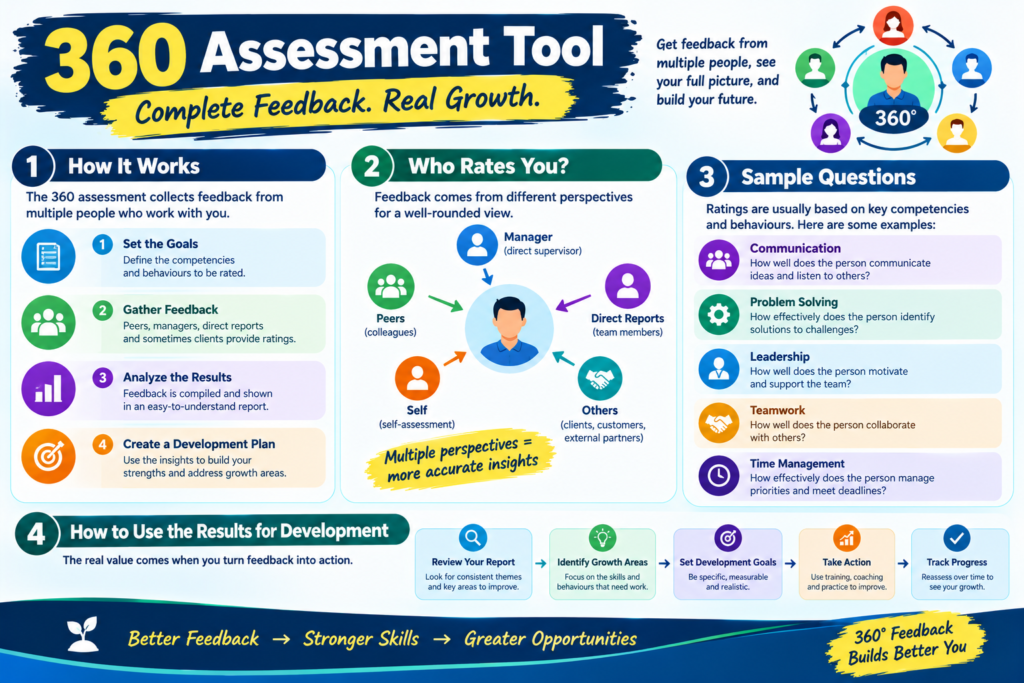
A 360 assessment tool answers a simple question from every angle: what is this person really like to work with? Instead of one manager's opinion, it gathers ratings from the employee, their manager, peers, and direct reports. As a result, the combined report shows strengths and blind spots that no single review can reveal. This guide walks through the process in plain language, adds 10 original practice items, and ends with a timed quiz game.
SHL's 360 tools add a forward-looking twist. Traditional 360 reviews look only at past performance, while SHL's version also measures future potential. Therefore development plans point ahead as well as back. The full journey runs from self-assessment through stakeholder feedback to results and a personal action plan.
360 assessment tool overview
| Detail | Information |
|---|---|
| What it is | Multi-rater feedback: self, manager, peers, direct reports, sometimes clients |
| Famous version | SHL 360 tools, including manager and leadership development versions |
| Main use | Employee development and leadership growth |
| Key difference | SHL 360 covers past performance and future potential, not performance alone |
| Process | Self-assessment, request stakeholder feedback, view results, craft an action plan |
| Pairs with | OPQ personality questionnaire: performance plus potential |
| On this page | Quick answer, the process step by step, 10 practice questions, a timed quiz and FAQs |
360 assessment tool: the quick answer
In short, a 360 assessment tool is software that collects structured feedback about an employee from raters at every level and turns it into a development report. Raters score observable behavior, usually anonymously, and the employee compares that self-view with how others see them. Consequently, the gaps between those views become the starting point for a development plan. In this role, it acts as an employee feedback tool that turns many views into one development plan.
- To begin with, raters include the employee, their manager, peers, direct reports, and sometimes clients
- Feedback targets observable behavior, not personality or private life
- Anonymity encourages honesty, especially from peers and direct reports
- Finally, results feed coaching and training, not punishment
The 360 review process, step by step
It starts with a self-assessment. The employee rates the same behaviors that everyone else will rate. Then they invite feedback from stakeholders, usually a mix of manager, peers, and direct reports.
After that, raters complete the questionnaire anonymously. Finally, the employee builds a personal action plan with their manager.
Above all, the comparison step matters most. When self-ratings run higher than ratings from others, that gap flags a blind spot worth working on.
In contrast, higher ratings from others reveal a hidden strength to use more often. Good programs keep the conversation focused on growth throughout, so results guide coaching and training rather than acting as a secret verdict. For the behavior model behind many 360 items, see our competency framework guide.
360 feedback questions
The 10 items below are original practice items written for this guide, and they double as 360 feedback examples. They are not real SHL test questions. For each scenario, pick the best answer, then check the explanations below.
- A Chicago sales manager gets low peer scores on sharing credit, while her self-score is high. What should her coach explore first? Options: A) Whether peers misunderstood the survey — B) The gap between her self-view and peer ratings — C) Her sales totals for the quarter — D) A new survey vendor
- An Austin software team runs its first 360 review, but only two of eight invited peers respond. What is the most honest way to read the report? Options: A) Treat two responses as the full team view — B) Note the thin response and gather more raters next round — C) Publish the two names to encourage replies — D) Skip the report entirely
- A Denver nurse manager reads a 360 comment naming a specific patient case. Why should she raise this with the program owner? Options: A) Because comments should stay short — B) Because identifiable details can break rater anonymity — C) Because nurses dislike written feedback — D) Because comments slow down reports
- A Seattle retail chain wants 360 scores to decide holiday bonuses. What risk does its HR lead need to flag? Options: A) Reports take too long to print — B) Raters will soften scores once pay is at stake — C) Managers dislike reading reports — D) Software costs will rise
- A new hire in Atlanta asks why direct reports rate their manager. What is the best answer? Options: A) Reports see daily behavior managers miss — B) Reports decide promotions — C) Reports replace manager reviews — D) Reports test software skills
Questions 6 to 10
- A Boston hospital runs 360 reviews every three years. What problem does that cycle create? Options: A) Reports get too short — B) Action plans go stale before progress is checked — C) Raters forget the software — D) Scores rise too fast
- A rater in Dallas scores a colleague low on strategic thinking but has never seen that work. What should the rater do instead? Options: A) Score from reputation alone — B) Skip items outside direct observation — C) Copy the manager's scores — D) Score every item at the midpoint
- An employee in Phoenix sees one harsh peer score and five warm ones. How should she weigh them? Options: A) Treat the harsh score as the truth — B) Look for themes across all raters first — C) Ignore every peer score — D) Ask HR to delete the harsh score
- A manager in Chicago turns 360 results into a coaching plan with two goals and monthly check-ins. Why does that structure work? Options: A) It punishes low scores quickly — B) It turns feedback into tracked action — C) It hides results from HR — D) It shortens the survey
- A company pairs its 360 review with the OPQ questionnaire. What does the pairing add? Options: A) A salary formula — B) A view of potential beside performance — C) Faster survey software — D) Fewer raters
Answers and explanations
Answers 1 to 5
- B. A gap between self-ratings and peer ratings is the classic blind-spot signal, so it deserves attention before anything else.
- B. Thin rater coverage weakens a report, so the honest move is to flag the gap and widen the rater group next time.
- B. Specific details can identify a rater, and anonymity is what keeps peer feedback honest.
- B. Once feedback affects pay, raters protect colleagues and honesty collapses.
- A. Direct reports observe day-to-day leadership closely, so their view fills gaps a manager's own boss never sees.
Answers 6 to 10
- B. A three-year gap leaves no timely check on whether the action plan changed anything.
- B. Credible 360 ratings cover observed behavior only, so unobserved items should stay blank.
- B. One harsh score may be noise, while a theme across raters is a real development signal.
- B. Specific goals plus regular check-ins convert a report into visible progress.
- B. The 360 covers performance while the OPQ covers potential, so the pair gives a fuller development picture.
Overall, one theme runs through every answer. Honest, behavior-based feedback that stays developmental helps people grow. However, the moment results become a punishment tool, raters stop telling the truth and the exercise loses its value.
How to get the most from a 360 review
- Score only behaviors you personally observed, and leave the rest blank
- Add a specific example beside a score whenever the tool allows comments
- Read for patterns across raters instead of fixating on one harsh score
- Turn the top two gaps into an action plan with dates and support
- Discuss results with your manager as coaching, not as a verdict
- Repeat the review after 9 to 12 months to check real progress
In short, the best 360 programs feel like coaching, not judgment. Play the timed quiz below to lock in the process, then see how feedback pairs with personality insight in our OPQ test guide.
Timed game: 360 feedback practice quiz
Play the timed practice game: 10 questions, 5 minutes on the clock, instant score and explanations at the end. No sign-up, no calculator.
Frequently asked questions
About 360 feedback
What is a 360 assessment tool?
A 360 assessment tool gathers structured feedback about an employee from self, manager, peers, and direct reports, then shapes it into a development report. Because ratings come from every direction, strengths and gaps show up clearly and no single view dominates. In addition, SHL's 360 tools measure future potential as well as past performance.
Who participates in a 360 review?
The employee rates themselves first. Raters include their manager, peers, direct reports, and sometimes clients. As a result, a mix of raters gives a rounded picture, while individual rater identities usually stay anonymous.
Is 360 feedback anonymous?
Individual ratings are usually anonymous, so raters can speak honestly. Meanwhile, the employee still sees grouped results, and managers may see the overall report for development talks. Therefore anonymity protects peer and report feedback from softening.
Using the results
Are 360 results used for pay or promotion decisions?
Good practice keeps 360 feedback developmental, guiding coaching, training, and action plans. Using it as a secret pay or promotion verdict destroys rater honesty. For that reason, most programs separate development feedback from formal performance decisions.
What should I do with surprising 360 feedback?
Start by looking for patterns across raters, then ask for specific examples behind the theme. After that, build an action plan around the top two gaps. A single harsh score may be noise, but the same theme from several raters is a real development signal.
How often should a 360 review run?
Most programs repeat every 9 to 12 months. That window leaves time to act on the action plan and show progress. Shorter cycles suit fast-moving roles, while annual cycles fit leadership development programs.
Related guides and jobs
- Verbal Reasoning Test: Questions & Answers
- Numerical Reasoning Test Questions & Answers
- Situational Judgement Test Questions & Answers
- Inductive Reasoning Test: Sample Questions
- Deductive Reasoning Test: Questions & Answers
- Assessment Test: Free SHL Practice Test Guide
- OPQ Test: SHL Personality Questionnaire Guide
- SHL Checking Test: Practice Questions & Answers
- Mental Aptitude Test: Free Practice Online
- Psychometric Assessment Test Online Guide
- Technical Skills Assessment: Practice & Guide
- Competency Framework Explained: SHL UCF Guide
- 360 Assessment Tool: 360-Degree Feedback Guide
- SHL Assessment Answers: What to Know First
- Smart Interview Method: Structured Interviews
- HiPo Analysis: Identify Future Leaders
- Behavioral Test: What Employers Measure
- Enterprise Leadership: Build Strong Leaders
- Skills-Based Organization Guide for US Teams
- What Is SHL? Assessments Explained Simply
- Wonderlic Practice Test – Free Sample Test
- Latest Jobs in Pakistan
2 thoughts on “360 Assessment Tool: 360-Degree Feedback Guide”