

A verbal reasoning test measures how well you read a short passage and judge statements about it under time pressure. Employers use it because the skill matches daily work: reading reports, emails and data, then deciding what the text actually proves. So, this page gives you example questions with answers, a timed quiz game and the strategy that raises scores.
Most verbal reasoning tests, including the SHL verbal reasoning test used by many large employers, follow one pattern. You read a passage, then mark each statement True, False or Cannot Say from the passage alone. Therefore, the golden rule is simple: judge only what the text states, never what you already know.
Verbal reasoning test overview
| Detail | Information |
|---|---|
| What it measures | Reading comprehension, logic from text, and accuracy under time pressure |
| Main format | Short passage, then statements marked True, False or Cannot Say |
| Also seen | Vocabulary, analogies, odd-one-out and word-relationship questions |
| Typical use | Pre-employment screening by large employers and graduate schemes |
| Famous version | SHL verbal reasoning test (Verify suite) |
| On this page | Quick answer, 10 example questions with answers, a timed quiz game, scoring tips and FAQs |
Verbal reasoning test: the quick answer
A verbal reasoning test is a timed assessment in which you read short passages and judge whether statements about them are True, False or Cannot Say, using only the information in the passage. Employers use it to predict how accurately a candidate handles written information at work. Most versions allow roughly one minute per statement set, so reading speed and discipline both matter.
- True means the passage states it or it follows directly from the passage
- False means the passage contradicts the statement
- Cannot Say means the passage does not give enough information either way
- Outside knowledge is a trap: even a true fact in real life is Cannot Say if the passage omits it
Topics in verbal reasoning
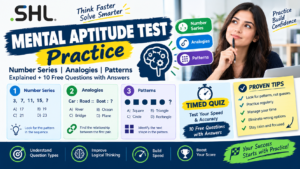
The topics in verbal reasoning stay narrow across providers. Firstly, passage-based statements test whether you can separate facts from assumptions. Secondly, vocabulary items test word meanings, opposites and similarities. Thirdly, analogy and odd-one-out items test how words relate to each other. In fact, every verbal ability test example on this page follows one of these three families.
Above all, graduate and professional roles weight the passage format most heavily, because it mirrors report reading. Meanwhile, some general-ability batteries mix in short verbal items beside numerical and inductive ones. In both cases, accuracy beats volume: a wrong confident answer scores the same zero as a blank. For the sibling skills, see our numerical reasoning test and deductive reasoning test guides.
Verbal reasoning questions with worked examples
Read this passage first. Then judge questions 1 to 4 against it.
Passage A: Remote work has changed how companies hire. A 2025 survey of 400 employers found that 62% now hire across state lines, up from 31% in 2019. However, the same survey found that fully remote roles receive three times as many applications per posting as on-site roles, which makes screening slower.
- More employers hire across state lines now than in 2019. A. True B. False C. Cannot Say
- Remote roles receive fewer applications than on-site roles. A. True B. False C. Cannot Say
- Most applicants prefer remote work. A. True B. False C. Cannot Say
- Screening for remote roles is faster than for on-site roles. A. True B. False C. Cannot Say
Passage B: The city library extended its opening hours in March. Since then, weekend visits have risen by 18%, while weekday visits stayed flat. The library credits the rise to students preparing for exams, though it collected no data on who visited.
- Weekend visits rose after the opening hours were extended. A. True B. False C. Cannot Say
- Students caused the rise in weekend visits. A. True B. False C. Cannot Say
Vocabulary and word questions (7 to 10)
- GENEROUS is the opposite of: A. Kind B. Stingy C. Wealthy D. Careful
- DOCTOR is to PATIENT as TEACHER is to: A. School B. Student C. Lesson D. Book
- Which word does not belong? A. Violin B. Guitar C. Trumpet D. Cello
- BRIEF and SHORT: the meanings of these words are: A. Similar B. Opposite C. Neither similar nor opposite
Answers and explanations
Passage answers (1 to 6)
- A. True. The passage gives 62% now against 31% in 2019.
- B. False. In contrast, the passage says remote roles receive three times as many applications.
- C. Cannot Say. Indeed, application numbers are given, but applicant preference is never stated.
- B. False. In fact, the passage says the volume makes screening slower.
- A. True. The rise followed the March extension directly.
- C. Cannot Say. The library believes students caused it, yet it collected no visitor data, so the passage cannot prove the cause.
Vocabulary answers (7 to 10)
- B. Stingy is the direct opposite of generous.
- B. A doctor treats a patient, and a teacher teaches a student.
- C. The trumpet is a wind instrument; the rest are string instruments.
- A. Brief and short share the same meaning.
Overall, notice how often Cannot Say is the disciplined answer. Worked examples of verbal reasoning like question 6 teach the core test skill: an opinion inside a passage is not evidence. In short, if the passage does not prove it, do not mark it True.
How to pass a verbal reasoning test
- Read the statement before the passage, then scan the passage for that exact claim
- Underline numbers and dates, because statements often twist one figure
- Treat words like always, never and most as warning signs of a False or Cannot Say item
- Never import outside knowledge, even when you are sure of the real-world fact
- Keep a pace of about one minute per statement set and move on when stuck
- Practice with timed sets, since reading speed grows only under a clock
In particular, scores improve fastest when you review why each wrong answer tempted you. For example, most errors come from assuming a cause the passage never proved. Then take the timed quiz above and compare your pace. Finally, round out your preparation with the situational judgement test guide, because employers often bundle the two.
Timed game: verbal reasoning practice quiz
Play the timed practice game: 10 questions, 5 minutes on the clock, instant score and explanations at the end. No sign-up, no calculator.
Frequently asked questions
About the test
What is a verbal reasoning test?
A verbal reasoning test is a timed assessment where you read short passages and judge statements as True, False or Cannot Say using only the passage. Employers use it to measure how accurately a candidate handles written information. Indeed, the SHL verbal reasoning test is the best-known version.
What topics are covered in verbal reasoning?
The main topics are passage comprehension with True, False or Cannot Say statements, vocabulary meanings and opposites, analogies, and odd-one-out word sets. Passage questions carry the most weight in graduate and professional hiring. Short verbal items also appear inside general ability batteries.
How long is a verbal reasoning test?
Length varies by provider and role. SHL-style verbal tests commonly present a series of short passages with several statements each, under a strict overall timer. So, the safe preparation rule is to practice at about one minute per statement set.
Scoring and practice
How is a verbal reasoning test scored?
Each correct answer earns one point, and your score is usually compared with a norm group of similar candidates. Employers then set a pass mark or percentile for the role. Above all, accuracy matters more than finishing, because wrong answers earn the same zero as blanks in most formats.
How can I practice verbal reasoning for free?
Work through the example questions on this page, read every explanation, and then play the timed quiz game above. Timed practice matters most, because the real test is a race against the clock. Repeat the quiz until Cannot Say items stop catching you.
Is the SHL verbal reasoning test hard?
The questions themselves use everyday language, so the difficulty comes from the timer and the Cannot Say trap. Candidates who practice the discipline of judging only the passage usually find the test manageable. Two or three timed sessions make a visible difference.
10 thoughts on “Verbal Reasoning Test: Questions & Answers”