
An HVAC service technician diagnoses, repairs, and maintains heating, ventilation, and air conditioning equipment at customer sites. Employers usually want proven troubleshooting experience, an EPA refrigerant certification, and a clean driving record.
This guide explains the daily duties and requirements. It also walks through a real commercial listing in Phoenix, Arizona, so you can see how an employer writes the job in practice.
What an HVAC Service Technician Does
A service technician responds to equipment problems and keeps systems running. Customers call when a unit stops cooling or heating. The technician travels to the site, finds the fault, and fixes it.
Most technicians also work on a maintenance schedule. They visit buildings at set intervals, inspect equipment, and replace worn parts before a breakdown happens. As a result, the job mixes emergency repairs with planned visits.
📲 Join our WhatsApp group for job alerts
Core Duties
Troubleshooting and repair
Technicians test electrical, mechanical, and refrigerant components to locate the cause of a failure. They then repair or replace the faulty part and confirm the system runs correctly. Strong diagnostic skill matters most here, because a wrong guess costs the customer time and money.
Preventive maintenance and reports
During a maintenance visit, the technician checks filters, belts, coils, and controls. They record what they found and what they changed. Clear service reports give the customer a record and help the next technician who visits the site.
Customer communication
Technicians explain the problem in plain language and describe the repair options. For example, they might tell a building manager that a compressor needs replacing and give a realistic timeline. Professional communication also builds repeat business for the employer.
Equipment Commercial Technicians Service
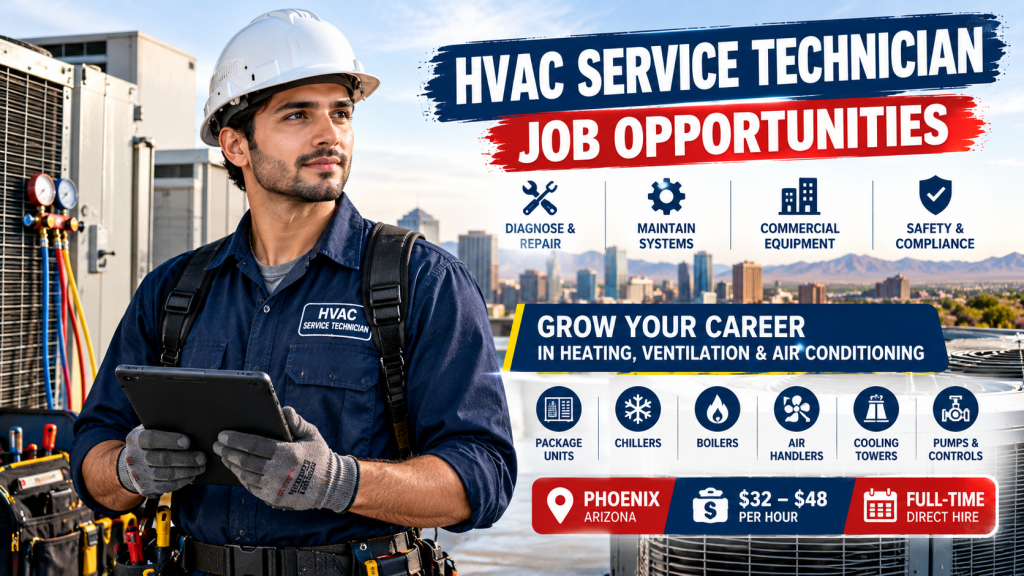
Commercial work covers larger and more varied equipment than most home systems. The Phoenix listing names the following:
- Package units: self-contained heating and cooling systems, often on a roof
- Chillers: machines that cool water, which then cools a building
- Boilers: machines that heat water or produce steam
- Air handlers: units that move conditioned air through ductwork
- Cooling towers: equipment that releases heat from a building’s cooling system
- Pumps, refrigeration equipment, and building controls
Experience across several of these machine types makes a candidate more useful to an employer, because one technician can handle more service calls.
Typical Requirements
Employers set requirements by role, so read each listing closely. The Phoenix example asks for the following:
- At least five years of commercial HVAC service experience
- Universal EPA certification
- Strong troubleshooting skills on commercial equipment
- A valid driver’s license with a clean driving record
The EPA certification refers to Section 608 of the Clean Air Act, which governs refrigerant handling. Universal certification covers all three equipment types: Type I, Type II, and Type III. Because technicians drive a company vehicle between sites, employers also check driving records.
Skills Employers Look For
Technical skill comes first. Employers want people who can read electrical diagrams, use diagnostic meters, and understand refrigeration cycles.
Soft skills count too. Technicians work alone at many sites, so they need to manage their time and make sound decisions without a supervisor present. They also need patience with customers who are dealing with an uncomfortable or costly breakdown.
Real Example: A Commercial HVAC Role in Phoenix
System One is recruiting a Commercial HVAC Service Technician for a client in Phoenix, Arizona. The role is direct hire, which means the client employs the technician, not the staffing firm.
The Phoenix listing at a glance
| Detail | Information |
|---|---|
| Job title | Commercial HVAC Service Technician |
| Recruiter | System One, for a client company |
| Hiring type | Direct hire (the client employs the technician) |
| Location | Phoenix, Arizona |
| Pay | $32 to $48 an hour, depending on experience |
| Experience | At least 5 years of commercial HVAC service |
| Certification | Universal EPA certification |
| Application deadline | Not stated in the listing |
Pay and benefits
Pay is listed at $32 to $48 an hour, depending on experience. The listed benefits include a company vehicle, medical, dental, and vision coverage, and a 401(k) with a match. The employer also lists paid time off, paid holidays, tuition and gym reimbursement, and relocation help for qualified candidates.
The ad shows the reference “#673-STS Denver” even though the job location is Phoenix. Therefore, confirm the location with the recruiter before you apply.
What the pay means
At a full-time schedule of 40 hours a week for 52 weeks, $32 an hour comes to about $66,560 a year. At $48 an hour, the total is about $99,840. These figures are straight arithmetic and leave out overtime, bonuses, and benefits.
The listing says pay depends on experience. Candidates with long commercial histories and broad equipment knowledge can reasonably expect to land higher in the range, though the employer sets the final offer. If you are comparing other US openings, see our Nursing Jobs 2026 – Fort Carson and Logistics Management Specialist Jobs 2027 guides.
Residential vs Commercial Technician Roles
Residential technicians usually service homes, so they work on furnaces, split systems, and heat pumps. Commercial technicians work on larger systems in offices, hospitals, schools, and factories.
Commercial jobs often demand more experience and more equipment variety. Residential jobs, on the other hand, tend to involve more direct contact with homeowners. Either path builds skills that transfer to the other.
How to Write the Job Description on a Resume
List results and equipment, not just the title. Keep each line short and start with an action verb. Here are example lines you can adapt, as long as they match your real work:
- Diagnosed and repaired package units, air handlers, and chillers at commercial sites.
- Completed scheduled maintenance visits and filed detailed service reports.
- Explained repair options to customers and kept work within agreed timelines.
Add your EPA certification level and your license status near the top. Finally, use the exact equipment names from the listing you are applying to, since employers often scan for them.
How to Apply
The listing does not state an application deadline or a specific method. Open the listing on the job board named in the original ad (usa.jobs) and use its apply option. Quote the reference number from the ad, and check with the recruiter that the position is still open.
Before you send any documents, make sure you are on the real listing. Never pay a fee to apply for a job.
Want more openings like this? Visit our international jobs category, check the private jobs section, or browse the latest jobs page. You can also read about a US military job fair in our NAF Jobs 2026 – JBLM Job Fair article.
Frequently Asked Questions
What does an HVAC service technician do?
They troubleshoot, repair, and maintain heating and cooling equipment. They also perform preventive maintenance and write service reports.
What certification do HVAC service technicians need?
Many employers ask for EPA Section 608 certification. The Phoenix listing specifically asks for Universal certification.
How much do commercial HVAC service technicians earn?
The Phoenix listing offers $32 to $48 an hour, depending on experience. Pay in other cities and companies will differ.
Is a commercial technician different from a residential one?
Yes. Commercial technicians service larger systems such as chillers and boilers, while residential technicians mostly work on home equipment.